A thousand years ago two maritime empires went toe to toe in the sultry waters of Southeast Asia. Few have probably ever heard of either of them.
First was mighty Srivijaya, the prime maritime trading empire of the great Indonesian archipelago, strategically placed midway between powerhouses India and China. Srivijaya sent its first embassy to Tang China in 645 AD, and its last nearly six hundred years later. Its maharajah sat on his throne in Palembang, southern Sumatra, and controlled the crucial Malacca, Singapore and Sunda Straits that provided all sea access between the Indian and Pacific Oceans.

Srivijaya seems to have risen as the earlier Champa Empire in modern Vietnam declined in the fifth and sixth centuries. Champa had been the ‘gatekeeper’ for trade to China, but when direct sailing across the South China Sea from Singapore Strait and Java developed, as opposed to coasting along the Thai and Indochina coasts, Champa lost much of the trade income from ships visiting its ports. Which, along with a little dynastic infighting, led to its decline.
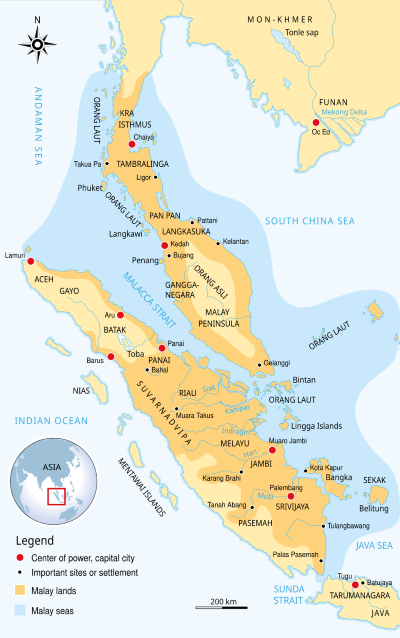
Up to this point, the Malacca Strait was a virtual no-go zone for shipping due to its reputation as a 400-nautical-mile-long pirate haunt, and most traders preferred to unload along the Thai and Malay isthmus coasts for land haulage across to harbours on the Gulf of Thailand.
Astutely, the rising Srivijayans came up with the solution to the pirate problem: they paid the pirates silver to protect the sea-lanes, and soon this security brought a huge amount of maritime trade right to their doorstep. And income. As trade and empire expanded, Srivijaya added vassals across Java, Sumatra, the eastern islands, Borneo, the Malay peninsula and north to Indochina.
And it was not just trade that gave impetus to Srivijaya, but cultural links too. Buddhism had spread from northern India along the Silk Road to China in the first and second centuries and had become the dominant faith in northern China. Pilgrimages to the sacred texts and holy schools in India went via Malacca Strait, and one seventh century monk noted over a thousand Chinese novices in Palembang, halfway through their voyage to India.
The Cholas, a Tamil-speaking Hindu power based in southern India were also a maritime-focused trading empire with links through Tamil communities across the Indian Ocean. They dominated the Bay of Bengal, eastern India and Ceylon from the ninth to the thirteenth centuries, and established trading communities along the sea route to China.
For the emperor in Tang China, the Cholas were one of the big four trading nations, along with the Persians, the Javans and Srivijaya. Concurrent flourishing of the Tang empire (618-907) with the spectacular wealth of the Bagdad-based Umayyads (661-750) gave a great push to Asian trade. In the ninth century, there were over 200,000 Arabs, Persians, Indian, Nusantarians and other traders living in Canton alone.

But old habits die hard, and it seems the ex-pirate ‘protectors’ of Srivijaya, could not resist old temptations, and were reputed to heard passing shipping into empire ports along the route to China, where they could be taxed.
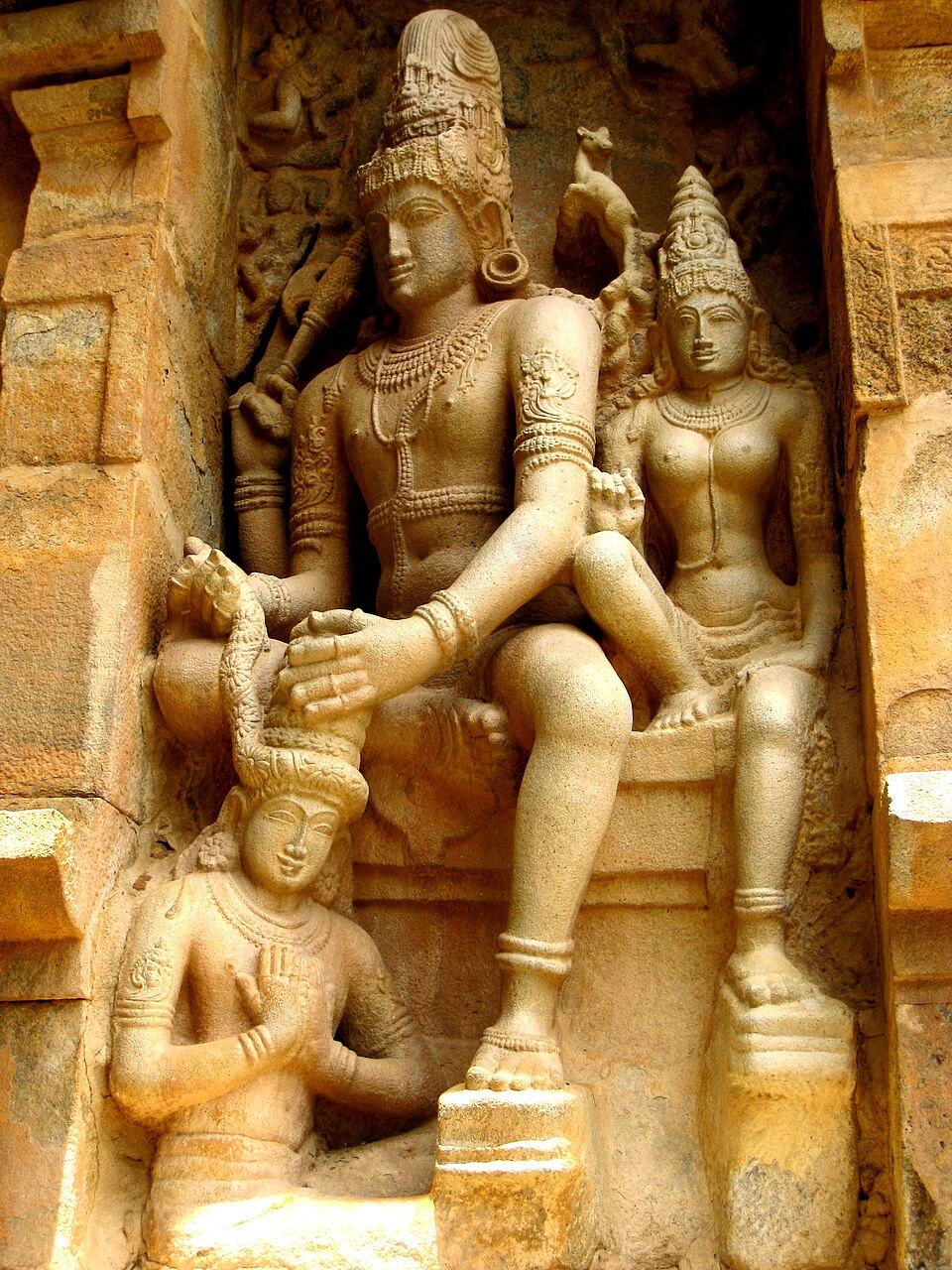
This eventually became too much to bear for the proud Cholas, and their emperor, Rajendra I (shown being crowned by Shiva in the lead illustration), decided to teach the Srivijayans a lesson. He was no newcomer to expeditionary warfare, having recently carried out amphibious campaigns against nearby Indian kingdoms, the Maldives and Ceylon. His answer was a single, powerful long-distance maritime raid that shocked his adversary, shattered some of his vassals, and led to ultimate doom for the great Srivijayan empire.
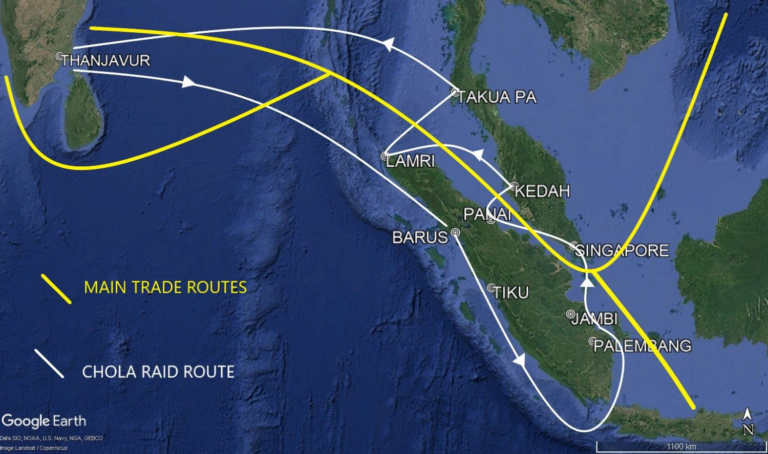
This impressive raid was remarkable for a number of reasons. Firstly, it was staged over a very long distance. Srivijaya itself mounted occasional seaborne raids into Indochina from Sumatra, of around 2000 km or so. The Chola raid in 1025 travelled 4000 km from southern India to Palembang, then 2000 km from there up Malacca Strait, and another 2000 km back to India to complete the circuit.
Secondly, to achieve surprise, the Chola fleet attacked from the ocean side west of Sumatra and through Sunda Strait, rather than down the sheltered Malacca Strait where the Srivijayan patrol squadrons were based; the first time such a manoeuvre is recorded.
Thirdly, they initially attacked Palembang with sufficient force to overwhelm the enemy capital–and it was located very defensively 70 km up the Musi River–proceeded to neutralise the opposing Srivijayan squadrons and then went on to devastate the empire’s tribute-paying states along Malacca Strait.
Finally, there was obviously some serious intelligence gathering and planning involved. It took time to assemble such a substantial fleet. The route had to be determined, supplies organised, manpower gathered, defences assessed, the location of Srivijayan patrol bases identified and all this took many months and needed to be kept secret.
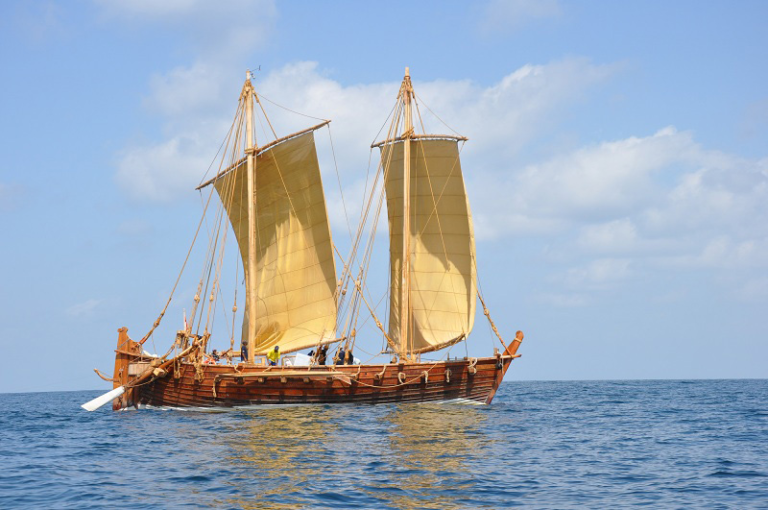
Unfortunately, we know nothing of the size of Rajendra’s armada, and only a little of the type of ships used. The Cholas had no standing navy, so the vessels were requisitioned trading ships, and suspected to be of two main types: large ocean-going but undecked colandia vessels of around 20 metres length; and smaller twin-hulled kutta-marans (from which we get the word catamaran) which likely transported troops to shore from the larger craft.
To overrun garrisons of several hundred soldiers–and we know the Srivijayan force at Kedah was around 200 men, so Palembang no doubt had more–would require at least a thousand warriors, plus sailors and other specialists. A twenty-metre ship would likely carry not more than a dozen to twenty in addition to the crew over long distances, so just to transport the troops needed around one hundred colandias, with supplies requiring many more. Which suggests a fleet of several hundred vessels.
The timing was no doubt based on the monsoons but would also have had to consider the southeast trade winds blowing from the Australian coast and the chance of tropical cyclones. Chola mariners would have been aware that cyclone activity peaks in May and November, and that the winter monsoon–blowing from the northeast through to about March–would provide their ride home. Most probably they set out early in the year, taking a few weeks to cross to Sumatra with the wind abeam, and then edged down the coast. They were familiar with the trade ports of Barus and Tiku and probably stopped there to rest and resupply.
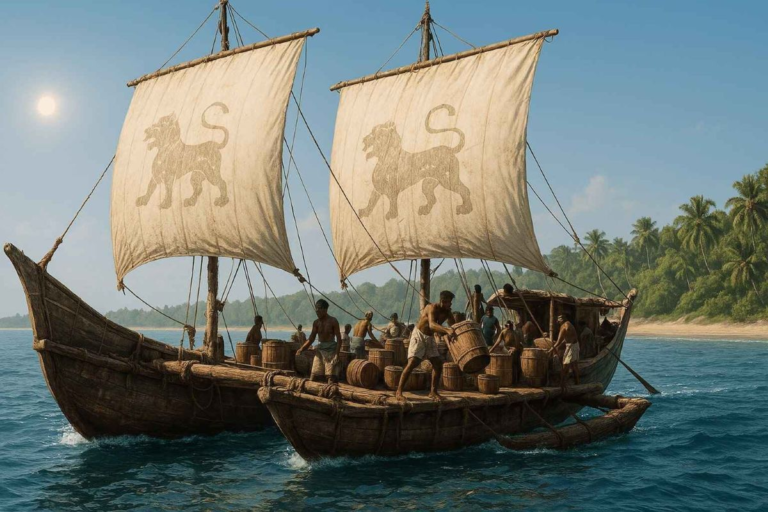
Perhaps they hit Palembang late in February or in March, overrunning the defences, pillaging the capital, capturing the maharajah (named Sangramavijayottunggavarman!), and loading up the legendary ‘Torana’ jewelled war gate to the city, among other trophies. They sailed north carrying out similar raids on Jambi (Sumatra), Singapore, Pannai (Sumatra), Kedah (Malaya), Lamri (Sumatra) and Takua Pa (Thailand) before turning west for home, stopping also at the Nicobars for a final stint of looting and plundering.
They did not bother to occupy any of their targets; they had no territorial ambitions. It was just a very spectacular raid and a punishment for perceived past Srivijayan injustices. No doubt the Srivijayan vassals wondered why the paid tribute to the maharajah in Palembang if not to prevent exactly this happening.
In fact, Srivijaya never really recovered from the Chola raid. In the aftermath, the capital moved to Jambi, and new leadership emerged, but kingdoms on Java–notably Majapahit–were growing in power, and soon overshadowed their Sumatran neighbour who had dominated them for the past six centuries.
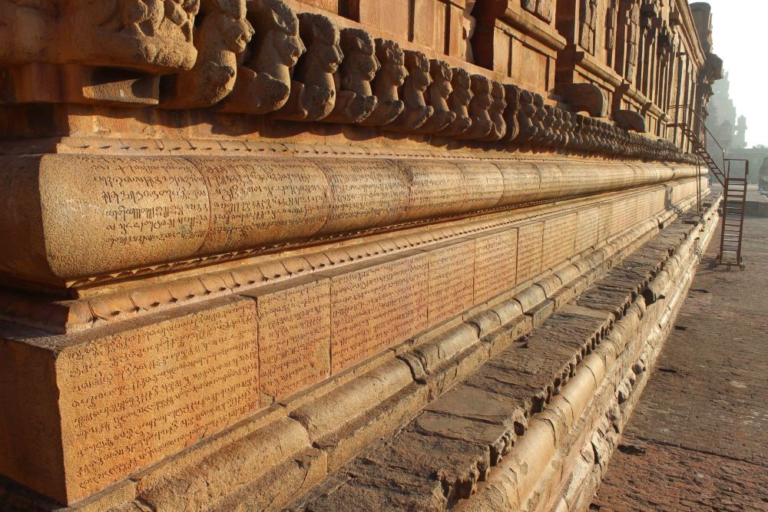
The Chola empire itself faced increasing competition in trade and military power from subcontinent adversaries and lasted a couple more centuries. Emperor Rajendra I ruled until 1044; the empire reaching its greatest extent under his reign. He also built the impressive Brihadisvara Temple in his capital, now Thanjavur, and it is from a Tamil inscription on this temple that we are told the story of the great raid. These curly engraved characters carved in stone celebrating a major victory are the only record we have of one of the most impressive maritime campaigns of the era.