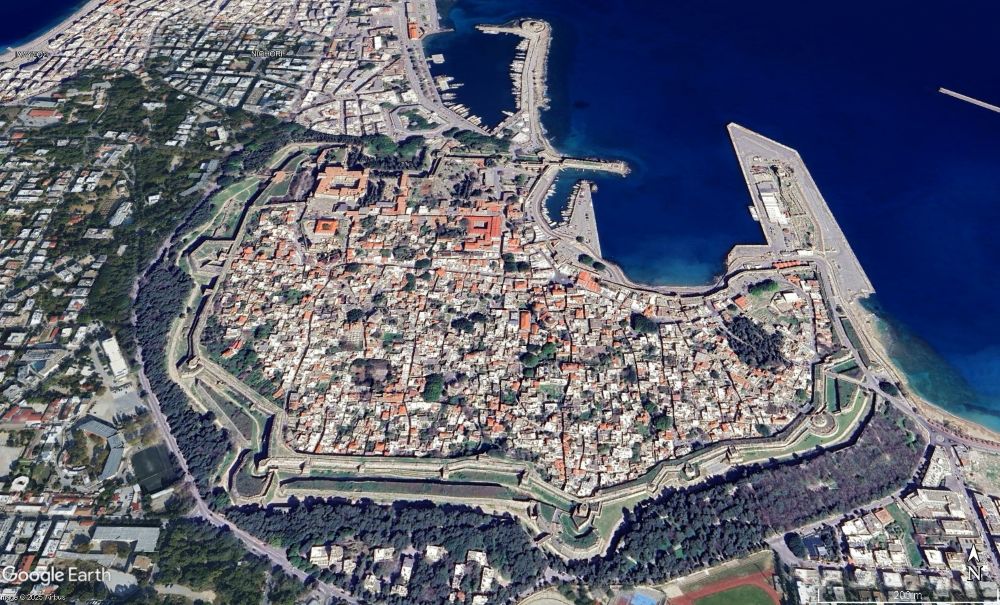
A UNESCO World Heritage site, the walled city of Rhodes is regarded as the largest authentic fortified medieval city in Europe. Frozen in time from when the Ottomans received its surrender after a bitter siege in 1523, its defences stand today much as they were 500 years ago.
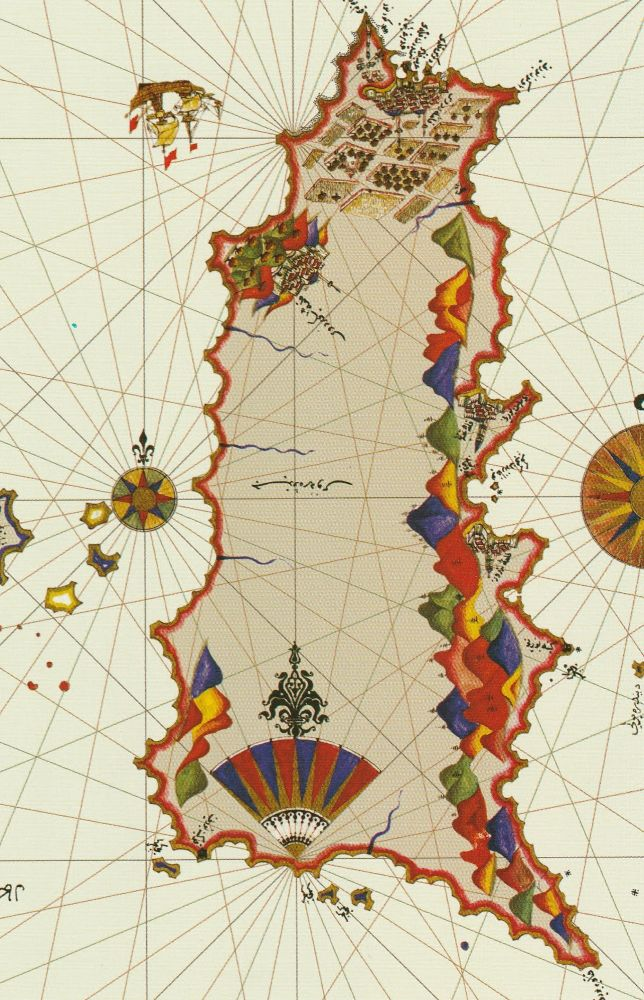
The Island of Rhodes from Ottoman Admiral and cartographer Piri Reis' 'Book of the Bahriye'. Rhodes city is at top of Rhodes Island. Just 17 km off the Turkish coast, the Knight's raiding from Rhodes always incensed the sultans, and it was only a matter of time before their patience ran out. Courtesy Boyut.
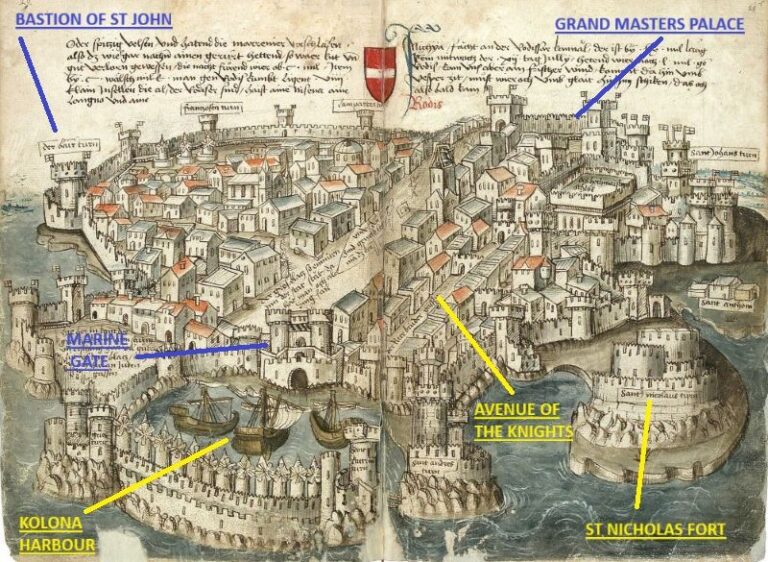
A rendering of medieval Rhodes from just before the final Ottoman siege by
Konrad Grünenberg. Many features can be seen in the following photos.
Rhodes has a history stretching back through the mists of time, back to the Age of Gods. Local legend has it that when the lands were divided between the Gods, Apollo (the sun-God and son of Zeus) was away, and returned a bit miffed that he had missed out. But then he saw a bountiful island emerge from the sea, and convinced Jupiter that it should be his. And Rhodes was and remains, the isle of the Sun-God.
At 77 km in length by maximum 35 km in width, it is the ninth largest island in the Med; larger than Corfu, but smaller than Crete. Generally, the landscape is mountainous though criss-crossed by fertile valleys, but there are also areas of coastal plains. Pine and cypress forests cover around half the island. It has a coastline of over 250 km, with many small coves and bays to shelter small vessels. On the island’s northern tip, lay the city and harbours of Rhodes city.
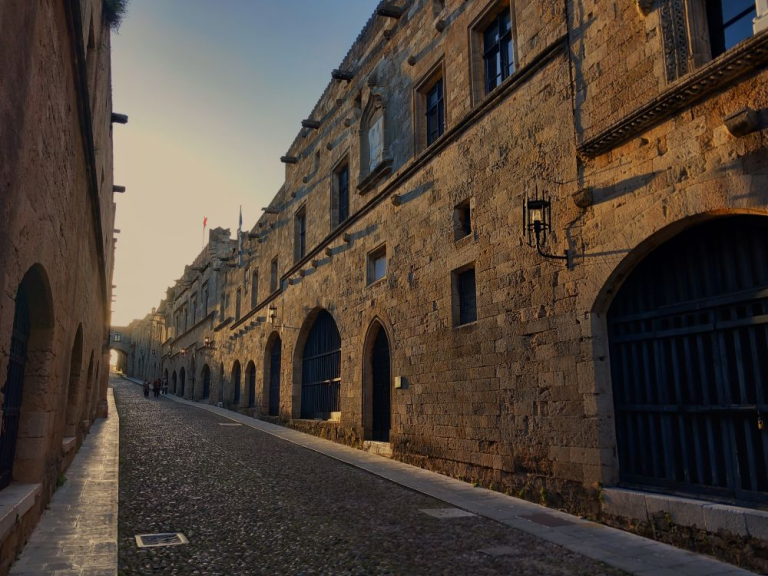
The Avenue of the Knights at sunset. It leads up to the Grand Master's Palace. Residences of the Knights, according to their language, were located in mansions along the avenue
Strategically situated at the cross-roads of the Eastern Mediterranean, Rhodes has an ancient maritime heritage. Closest of the Greeks to the riches of Egypt, on the edge of Asia Minor and at the crux of the Meltemi, the Levanter and the Sirocco winds, it’s craggy coastline hosted ports and harbours from Antiquity.
The Iliad mentions the proud Rhodians sending nine ships to besiege Troy. Later, Minoans and Myceneans had bases there. It was unsuccessfully besieged by the Persians in 490 BC, and again by Demetrius in 305 BC during the wars of Alexander the Great’s successors. But even in ancient times, Rhodes had formidable fortifications, and he too could not manage to breach the city walls, leaving all his expensive siege equipment behind.
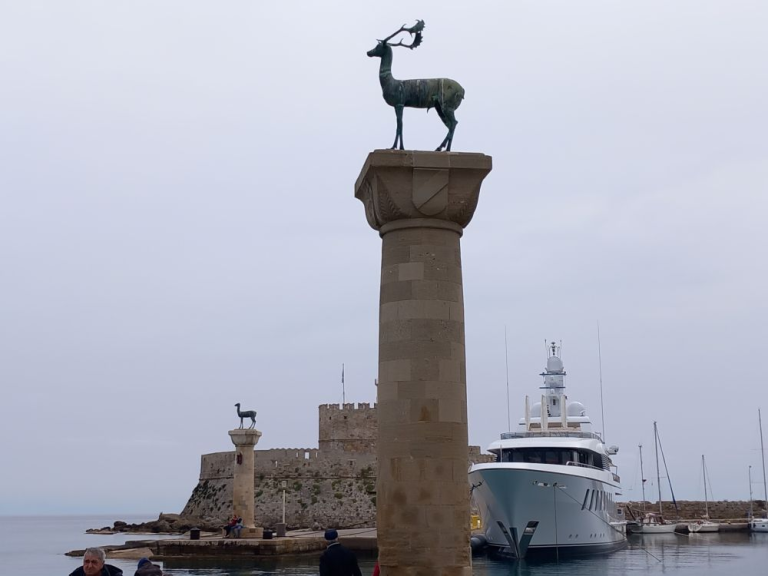
Two stags on columns stand either side of the entrance to Mandraki Harbour. Legend has it the Colossus stood with a foot where each stag now stands. Experts point out that such a huge statue - at over 30 metres, the tallest in the ancient world - could never stand as such with feet spread, and it likely was located in a different spot, with feet together
The Rhodians sold all this equipment, and built the Colossus with the proceeds. And so, one of the Seven Wonders, their tribute to Helios, graced Rhodes’ main harbour for over 50 years. Until toppled by an earthquake.
Then came the Romans, who subdued the independent spirit of the islanders, and absorbed them into their Empire. Later, followed the Byzantines, Persians, Saracens, Seljuk Turks, and the Genoese. Rhodes location meant it was very contested. And hence fortified.
A plan of the walls and bastions of Rhodes, courtesy Aga Khan.
In 1306 the Knights Hospitallers, evicted from the Holy Land, decided to establish their base there, and they fought the Byzantines for four years to wrest control of the island. Once in, they would be very hard to evict, holding the coveted island until 1523. The Turks tried invading already in 1320, and threats from Genoa, the Byzantines, the Egyptians and the Arabs quickly convinced the Knights to invest heavily in their fortifications.
The Knights surge in to Rhodes early in the fourteenth century, wresting control from the Byzantines. Already the defences were so strong it took them three years to capture.
Not only were various attackers a threat to the walls, but earthquakes hit regularly (one had toppled the Colossus), and soon a new problem developed. Cannons started to come into widespread use, and they were very good at fast-tracking sieges. The thousand-year-old Byzantine Empire fell when Ottoman cannons blasted through its very sophisticated triple walls in 1453. It was a wake-up call for the Knights on Rhodes.
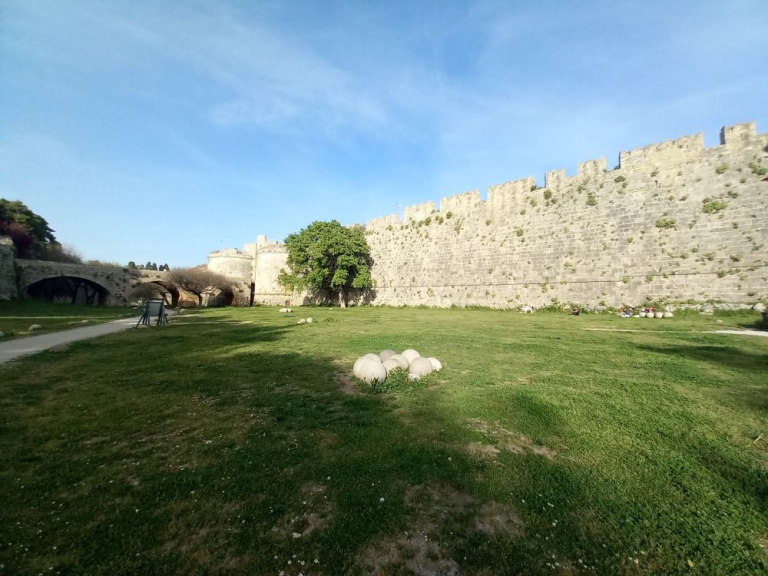
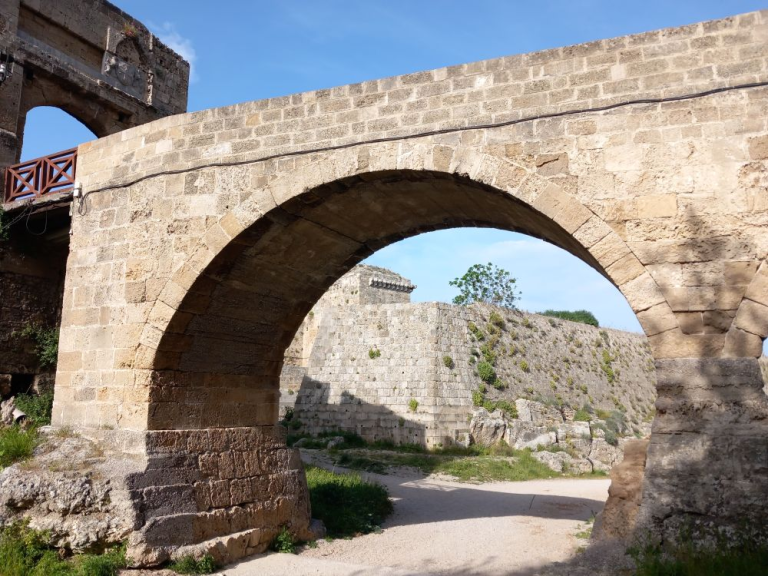
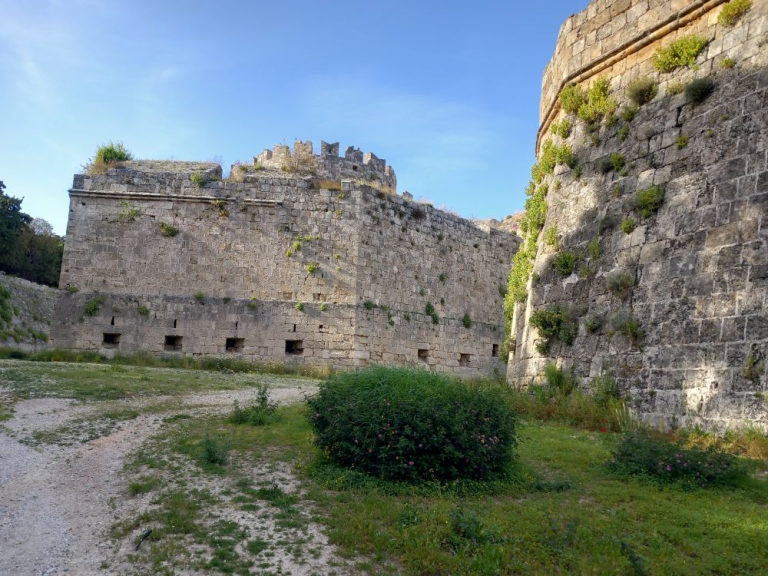
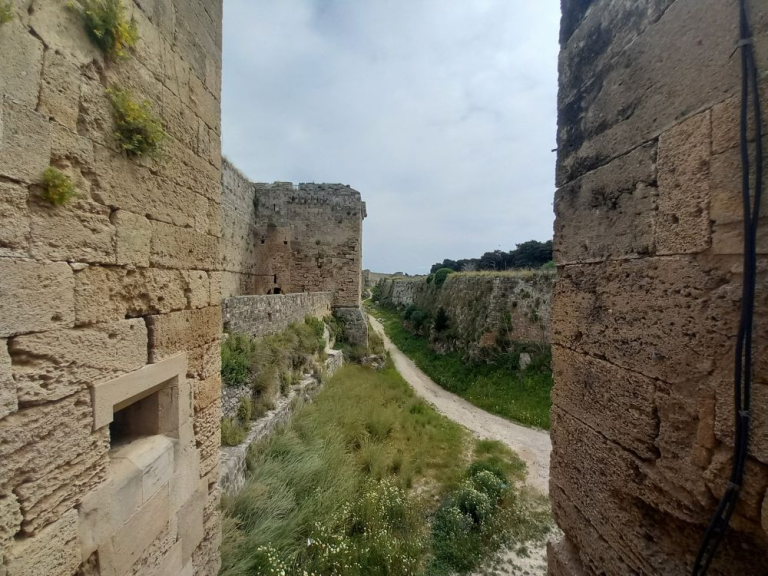
The Knights were superb military engineers and adopted the latest defensive structures to defend the city. This view looks across the dry moat to the high walls near d'Amboise Gate. It was a long way to run with a ladder while being shot at. The grounds are still scattered with granite cannonballs from the siege.
Gone were the high, thin walls and square towers of medieval times that were easy to smash with gunfire. The new science of fortifications required the trace italienne system of lower, wider stone bastions to both mount cannons, and to resist their fire. The solid rock that sits under the fortress, quarrying more blocks of limestone and defences for the harbours themselves all presented the engineers with considerable difficulties.
To keep the Knights focused on their upgrading works, the Egyptians laid siege in 1444; some bastions perished in a flood in 1476; the Ottomans attacked in 1480, coming very close to overwhelming the defences; and earthquakes struck in 1481 and 1513.
Long expected, the Ottomans were back in the summer of 1522, landing 100,000 men from 400 ships, and setting up their great guns to blast through the land walls. The outnumbered defenders had to repel almost daily infantry attacks, ships kept pressure on the sea walls and harbour forts, miners dug tunnels and set off mines, dropping sections of wall, and ammunition ran short. Three-quarters of the defenders had perished and no reinforcements could make it through the blockade.
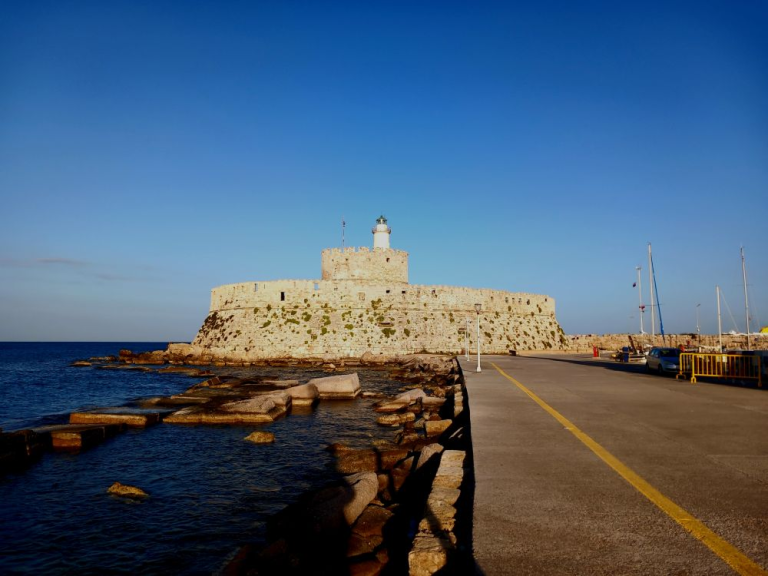
The Sea tower and fort of Fort St Nicholas provided the main defence for Mandraki and Kolona Harbours. It was supported by another work, De Naillac Tower, which was toppled by an earthquake in 1863.
But the Ottomans were also near exhaustion. Some reports have 64,000 Ottomans dying in battle over the six months of siege, with many more perishing of disease. In the end, Suleiman the Magnificent offered the Knights terms, which allowed them to depart with their weapons in return for handing over the fortress. The few that remained alive accepted and departed flying their colours, heading for their next headache for the Turks, Malta.
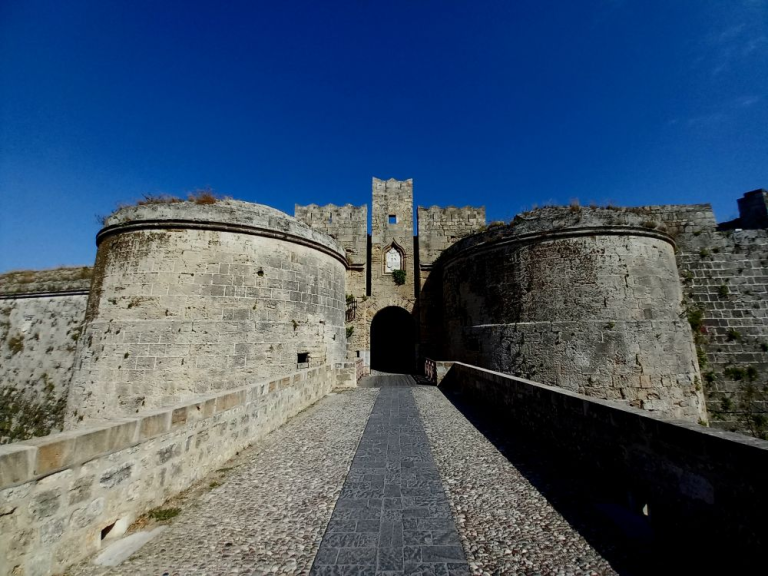
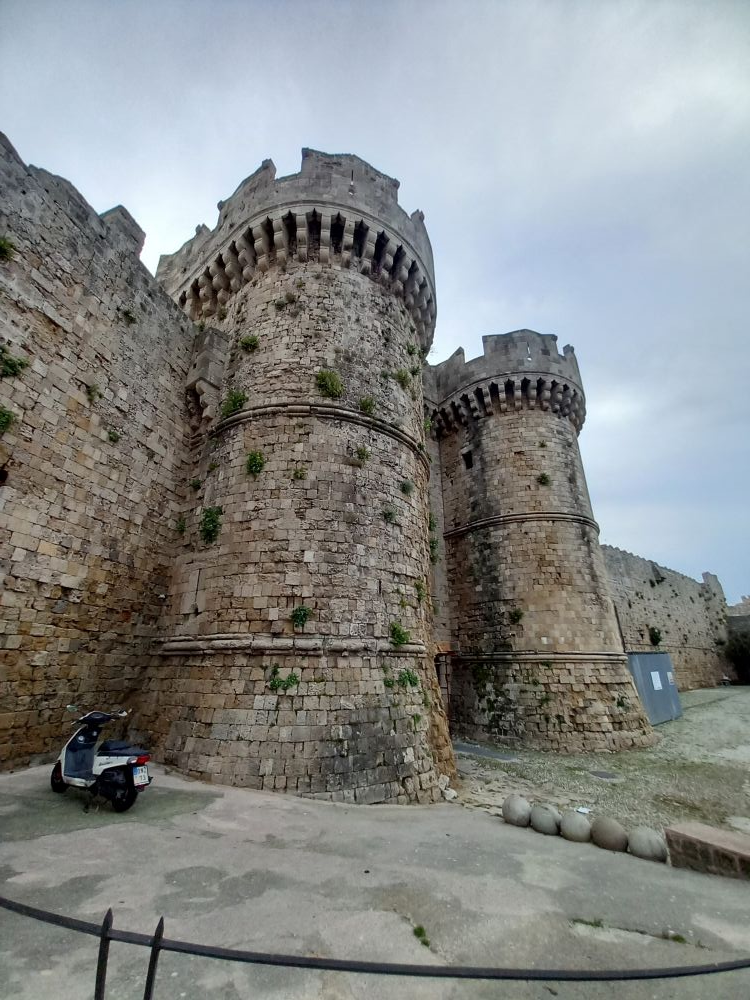
The imposing d'Amboise Gate, one of 11 around the circumference of the walls.
The Ottomans took possession of a battered fortress, but considering that either the Knights or the Spanish or some other Christian force was likely to be back, they set about repairing the damage. The fortress design was state-of-the-art and rebuilding rather than redesigning was required. After all, those defences had kept them out for six long months.
With time, as Ottoman domains expanded past Rhodes, the fortress became a backwater, and further upgrading over the centuries was not required. The defences of Rhodes were frozen in 1523, and unlike almost all other European fortified cities, the sixteenth century defences were not demolished for new designs in the seventeenth and eighteenth centuries. What remains is a time warp from the Middle Ages; one of the absolute best examples of early Renaissance fortress architecture anywhere.
Rhodes is well worth a look. But, like all places on the Med, peak summer is not the time to visit. A couple of cruise liners are normally present, disgorging many more people than reside in the old town. Mid-spring or mid-autumn are less busy.
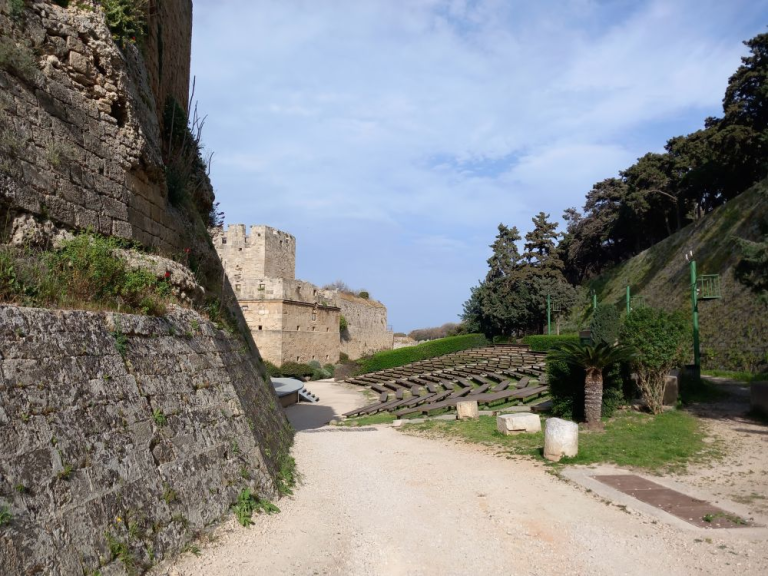
The Melina Merkouri Moat Theatre sits just outside the curtain walls, with the Bastion of Italy behind. Performances are held during the summer. You can walk the entire circuit of the old walls, either on top of the defences (from April on) or down in the moat.
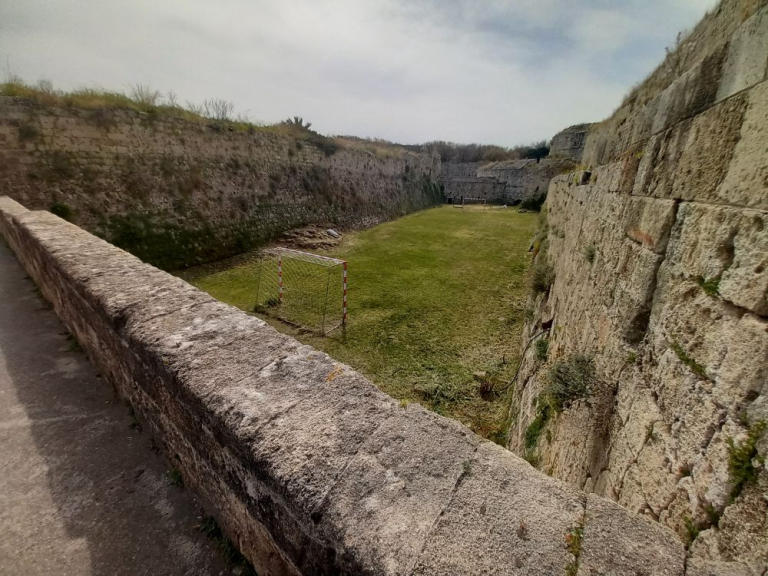
A soccer field is wedged awkwardly between the Italian Tenaille and the Akandia Gate. As a sports ground, it has some serious limitations.
The Gate of St John was part of the Bastion of St John, one of the most sophisticated defensive works on the perimeter. 10,000 Turks are said to have died trying to storm it in 1522. Out of respect for their sacrifice, the sultan rode into the city through this gate in early 1523, and then ordered it sealed, so no other conqueror could follow him.
The Tower of Spain was actually captured by Turks in September 1522, but retaken by Knights led by the Grand Master himself. The Tenaille of Spain is on the right.
Intimidating defences between the Bastion of St George and the d'Amboise Gate.
The impressive Marine Gate was once lapped by the harbour's waves. It dates from 1478.
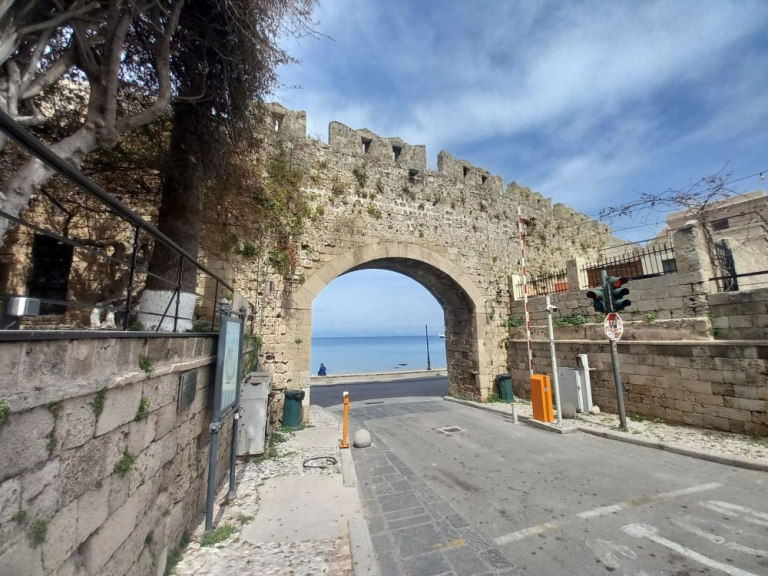
The Gate of the Virgin Mary is a modern gate to allow traffic to exit the old town, built in 1955. The Turkish coast can be seen in the distance.
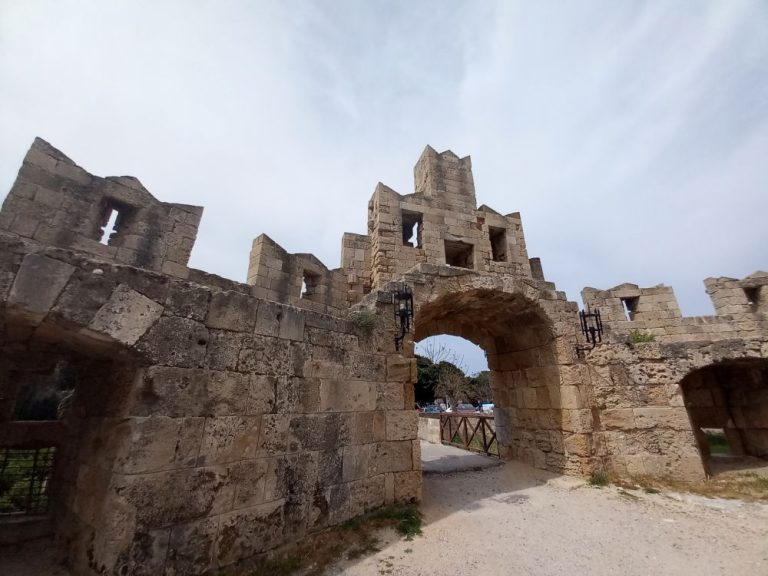
Still decorated with marble crests and inscriptions from the fifteenth century, the Gate of St Paul formed part of the harbour defences, linking St Nicholas Fort and the now-missing de Naillac Tower.
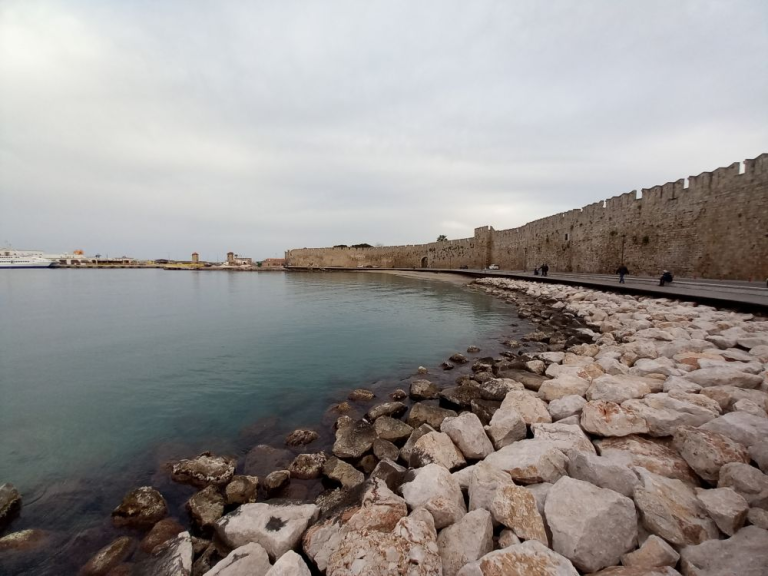
Sea walls stretch along the coast guarding Kolona Harbour. In the time of the Knights, Kolona was the commercial port, and nearby Mandraki base of the military galley fleets. In the centre of the photo is the plinth on which de Naillac Tower stood.
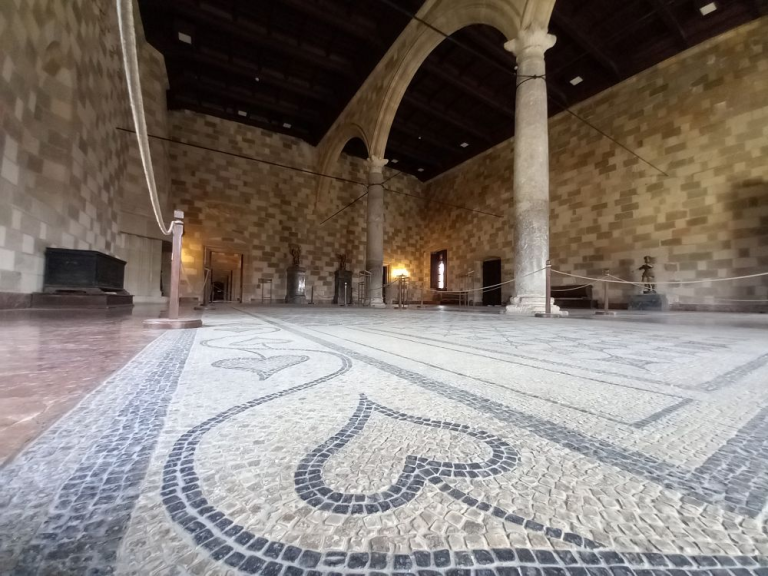
Inside one of the amazing rooms of the Grand Masters Palace, now a museum to the Knights and Rhodes.
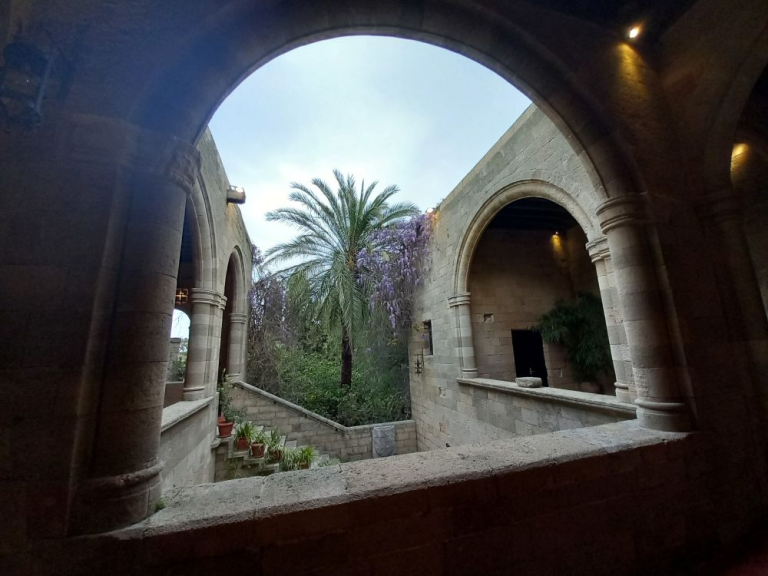
The French Consulate occupies one of the old residences along the Avenue of the Knights, giving a tantalising view into how they looked when the Knights were home, 500 years ago.
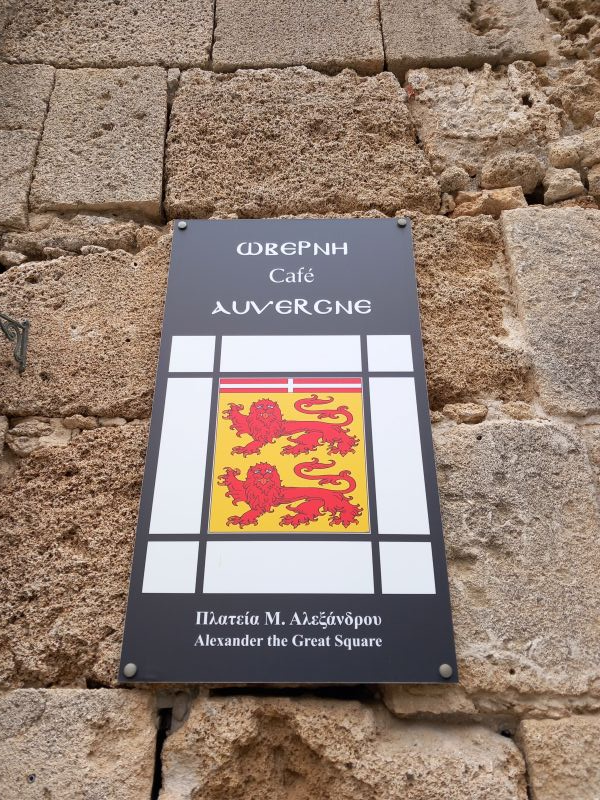
The crest of the Knights of Auvergne along the Avenue of the Knights.
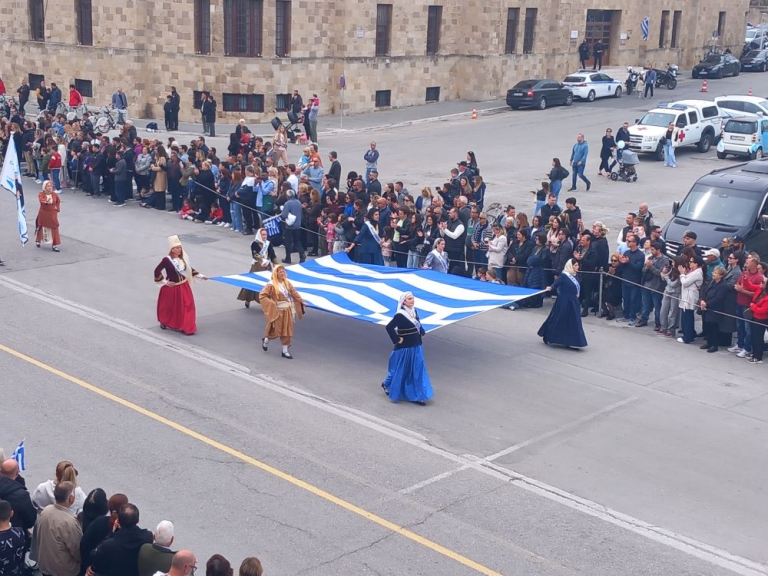
We were lucky enough to catch Greek Independence Day celebrations on March 25 while we were in Rhodes. The proud locals put on a very impressive parade. Of course, there is also a great deal to see out of the city of Rhodes, if you have some time on the island. The ruins at Lindos should not be missed.