
GREEK FIRE: The mystery revealed?
Cloaked in an aura of myths and invincibility, Greek fire excites the imagination because it is a lost technology; an expertise mankind once possessed, now vanished into the sands of history. Surrounded by the breakneck pace of modern technology development, it is intriguing to realise that there is knowledge we once possessed but today have lost.
The legends surrounding Greek fire have developed over the centuries into some fantastical myths, but even with these stripped away, the truth is very entertaining. Scholars and enthusiasts have long heatedly argued over the concept of Greek fire, the weapons and tactics employed, the secret recipe of the concoction, the apparatus to pressurise and ignite it and the impact of its use on early medieval combat.
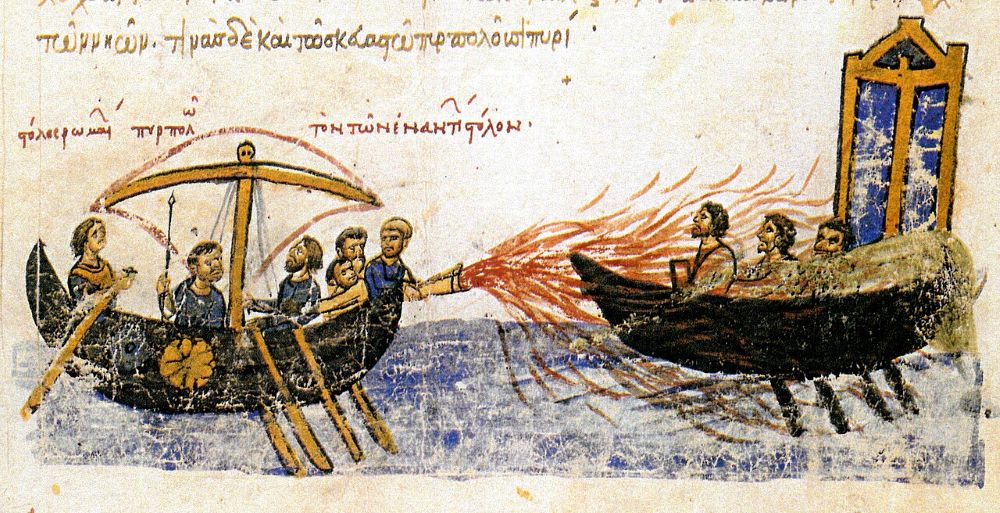
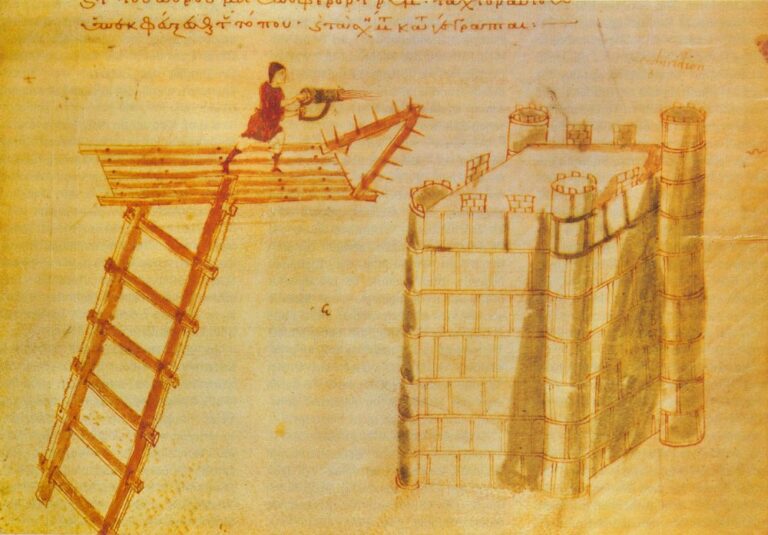
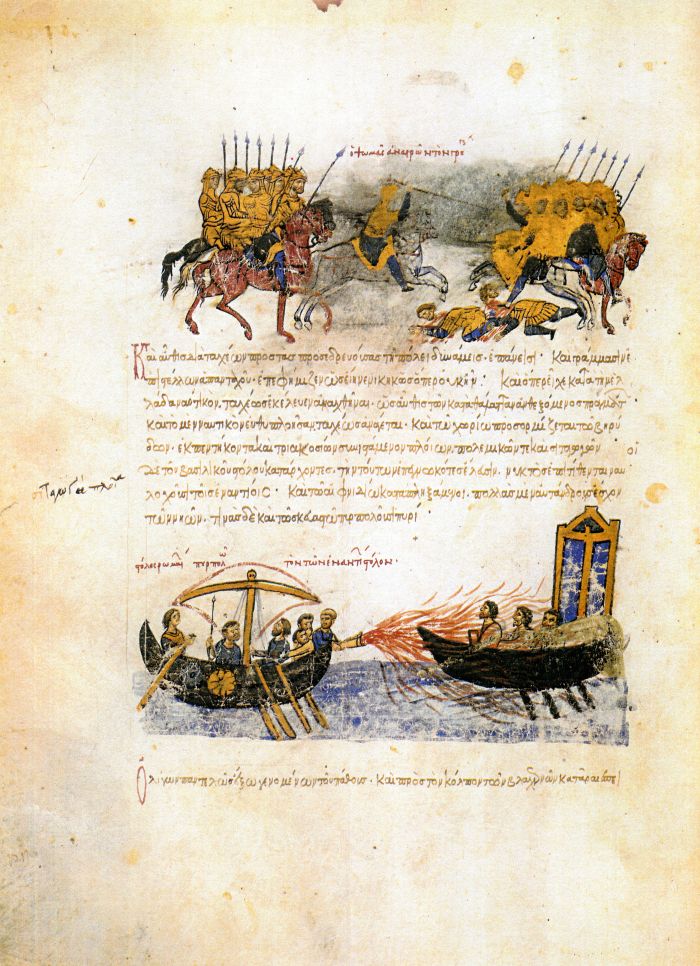
In short, Greek Fire was an early marine-based flamethrower, capable of setting fire to opposing ships at short ranges. Back then, of course, all ships were built of wood. At times it was also used as a land-based weapon, employed from fixed fortifications. Its employment was almost exclusively attributed to the Byzantine (ie, Eastern Roman) empire. Arabs and Bulgars reportedly captured supplies and apparatus at various times but were unable to operate the combination effectively.
What was it?
Much energy and ink have been spent trying to define what it was. What it wasn’t was any kind of explosive, or incendiary device fired by catapults. These certainly, were contemporary weapons, in use from Greek and Roman times, but Greek fire was different.
Actually, it was a system rather than a single item. Byzantine sources referred to the overall system as a siphon, and it consisted of a flammable substance pumped from a storage container, then heated over a fire or hearth, and ejected under pressure from a swivel that provided ignition as the fuel left the nozzle. Clearly, an early flamethrower.
Because it was petroleum-based, the liquid floated on water, burnt on water and could not be extinguished with water. Reports that it ignited on contact with water have been disproved.
Speculation about the supposedly long-secret recipe known only to emperors also skirts the facts that, broadly speaking, the substance was clearly a mixture of light crude petroleum with resins added to assist ignition, burning intensity and viscosity, as has been proved by recent tests.
Byzantine use of Greek fire
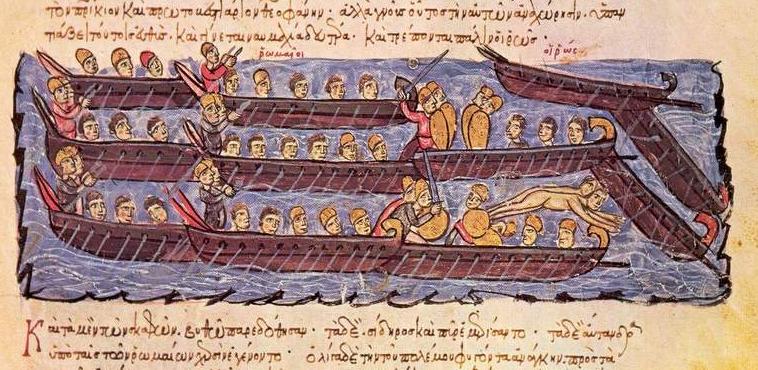
The first recorded use was in the defence of Constantinople against Arab warships in 674-8 AD, where massed fleets of attackers were defeated by a smaller squadron of liquid fire-equipped Byzantine ships.
A further Arab attack in 717-8, where a large fleet landed a huge army to besiege the great walls, was similarly smashed by fire-breathing imperial vessels, leading to a spectacular Arab defeat.
In 727 and again in 823, rebel fleets were destroyed or repelled by Greek fire sprayed from imperial dromons and biremes just off the walls of Constantinople.
The Byzantines certainly attracted attackers, and in 941 a Rus fleet supposedly totalling 1000 ships from Kiev came down the Bosporus when the imperial fleet was pre-occupied with Arab battles in the south. Just fifteen old galleys at Constantinople were quickly fitted with the Greek fire apparatus and proceeded to torch the astonished Rus flotilla. Reports indicate that each Byzantine ship was equipped with two or three syphons each, at bow, stern and sides.
In 970, a flotilla on the Danube–also armed with Greek fire weapons–blockaded the river, strangling the Bulgars into submission.
In the 1180’s and 1190’s again use of Greek fire is recorded against Venetian and Pisan ships by Byzantine forces in the wider Mediterranean.
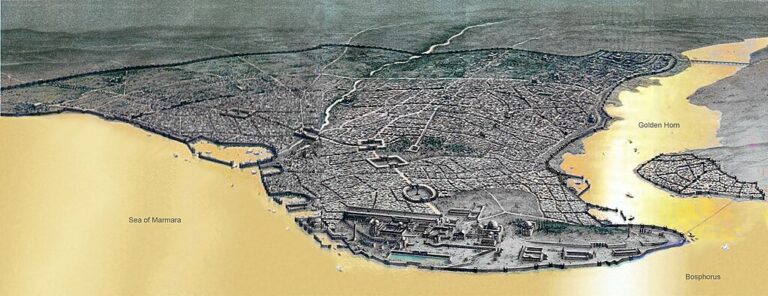
But Greek Fire could only be used in certain conditions and with significant limitations. The weather had to be perfect, the sea calm with no wind. Today, the Sea of Marmara and the Bosporus are notably windy locations, so such issues would have seriously impinged on its usefulness. The other critical aspect was that the range of the ‘flamethrowers’ was very low, probably a dozen or so metres only. And of course, the Byzantine ships were also of wood, so accidental self-immolation or burning enemy vessels crashing into your own were real dangers.
How did it work?
Many researchers and enthusiasts have sought to reinvent the system, or set themselves alight trying, over recent centuries. Perhaps most convincing was a series of experiments by scholar John Haldon and his team, culminating in an enlightening demonstration in 2002.
Basing their equipment on the most reliable of Byzantine-era written observations and using only traditionally available materials, Haldon & co. produced a forged bronze two-man double cylinder force-pump, which provided the required pressure; an oil reservoir and heating system; solid pipework and a swivel nozzle for igniting and directing the blazing substance.
One vital element was the cylinder pump’s piston system, which was based on archaeological water pumps from the era, with the piston heads sealed with leather and tallow. The nozzle was bronze, and seals allowed it to swivel up and down and left and right, as observers noted was possible.
For the liquid fire, a light crude from Azeri fields was used. Six kilograms of various pine resins was added to a 50-litre drum of oil to increase combustion duration, and the mixed product was heated to 60 degrees Celsius to make it viscous, so it would not block all the valves and flanges with residue. The danger of blowback from the nozzle into the reservoir was dealt with by physically separating the heating process and the firing nozzle and fitting a non-return valve.
Flax fibres were used to provide an intense, fast heat source for the brazier, and these roared when the brazier was worked. A similar roaring was evident when the hot fuel was ejected from the nozzle, under pressure from the pumping system; a characteristic noted by observers that terrified their targets. Ignition of the fuel as it left the nozzle was provided by a small tub of oil-soaked hemp just in front of it.
The system when operated in a mock battle roared loudly, belched thick black smoke, generated intense heat, and destroyed a mock timber boat with several multi-second jets at a range of 10-15 metres. The mystery solved?
The end of Greek fire
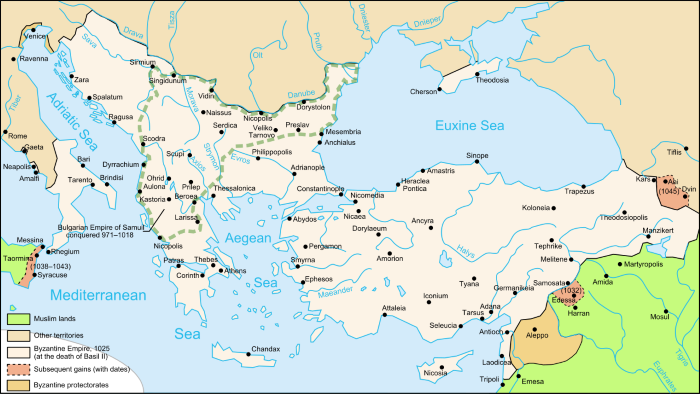
Some claim it to have be an all-conquering technological wonder weapon that ensured survival of the Byzantines, enabling them to defeat all foes and confirming their mastery of sea warfare, and maybe there was truth in that. Perhaps coincidentally, perhaps not, Byzantine decline coincided with their loss of access to the Caucasus oilfields during the eleventh century.
Petroleum oil provided the basis for Greek fire, and in Byzantine times, this was sourced from the North Caucasus: today the location of major Russian and Azerbaijani oilfields. These deposits are known for light crude, paraffin-rich, low in impurities and highly inflammable, and, importantly, where seepage from the surface is and was common.
These areas were near the frontiers of the Byzantine Empire at its peak, but by the twelfth century the rising Ottomans had subsumed much of Anatolia, cutting Constantinople off from its petrol source.
When the Fourth Crusade diverted from recapturing Jerusalem to pillage Constantinople in 1204, just when the Byzantines again needed their wonder weapon, there was clearly no stock of Caucasus oil to fry the French. Constantinople fell for the first time in a thousand years, and though the capital was recaptured and struggled on until Turkish cannons blasted down its walls in 1453, for its last two centuries, it was just a shadow of its former strength.
And with the death of Constantinople and the empire, the secrets of Greek Fire died also.

Sources: The main source is a technical journal article by John Haldon with contributions by Andrew Lacey and Colin Hewes, titled ‘Greek fire’ revisited: recent and current research from Cambridge University Press, 2006.