In November 1912, the powerful Ottoman armoured cruiser Hamidiye stood off Bulgaria’s main port, Varna, and its captain, Rauf Orbay, sent a message to the governor. Surrender immediately, or the ship’s heavy guns would destroy the city.
Bulgaria, which with Russian help had gained semi-independence from the Ottomans only in 1878 after 500 years of brutal occupation, was allied with Greece, Serbia and Montenegro against the Ottomans during the seven-month struggle that became known as the First Balkan War. Though Bulgaria fielded a decent army and had already beaten the Turks on land, they lacked any large ships able to take on the Hamidiye.
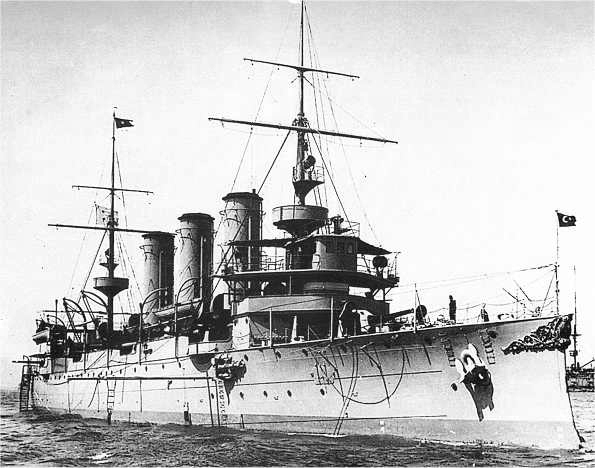
The most modern warship in the Ottoman fleet in 1912, the British-built armoured cruiser Hamidiye.
The Ottoman ship was a modern cruiser built at Newcastle in England in 1904 displacing 4000 tons with a crew of 400 men. Sixteen steam boilers developed 12,000 horsepower and gave her a speed of 22 knots which was pretty fast for 1904. Her main guns were two six-inch Armstrong rifles that could put a 45 kg shell out over 13 kilometres. To back those up, she carried eight 4.7 inchers in single mountings. Twelve lighter quick-firers completed her gun armament, giving a formidable amount of firepower. She also carried two newfangled torpedo tubes and was equipped to lay mines.
Under Orbay since 1909, Hamidiye had already put down a rebellion in Albania and operated against the Italians in the Mediterranean during the earlier Ottoman conflict with them. Now in the Black Sea, the cruiser and its captain sought to reverse Turkey’s poor army record with some revenge from the sea.
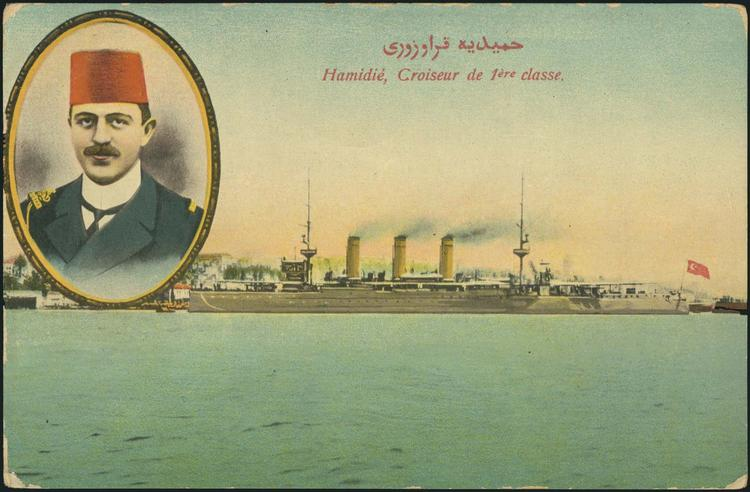
Awarded a citation for his actions during the First Balkan War, this image shows Captain Orbay and his cruiser Hamidiye. Courtesy Karamitsos
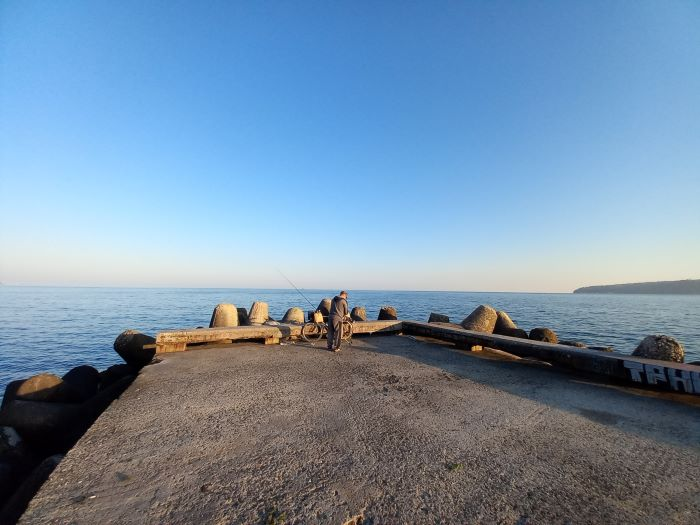
The Black Sea off Varna, looking east to where the battle occurred.
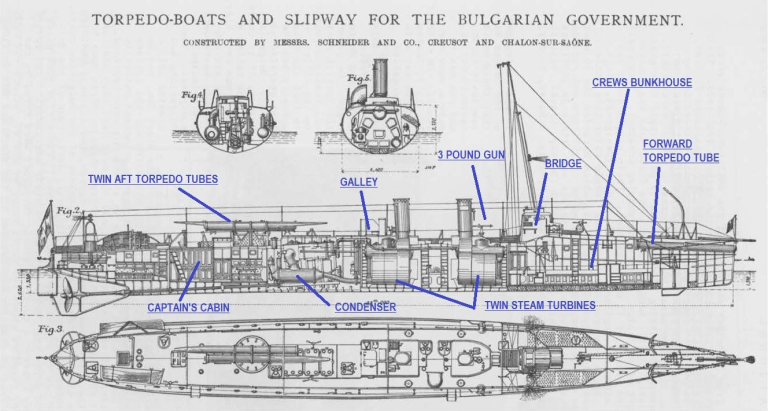
The entire Bulgarian Navy at the time consisted of one royal yacht–which had just run aground–and five small torpedo boats. These were new French-designed craft of less than 100 tons that had been built in Varna with French expertise, and launched in 1907-8. Forty metres long and just four wide, their steam engines generated nearly 2000 horsepower to give them 26 knots. They carried three 18-inch torpedos and two small three pounder guns, all manned by a crew of two dozen sailors.
Back then torpedo boats could present a real threat to a ship like the Hamidiye, but the technology was very new. The first self-propelled torpedo was only developed in 1866, and the first operational torpedo boat, HMS Lightning, only appeared a decade later. While they were flamboyant and fast, they were also delicate and easy to disable with modern quick-firing guns. Torpedos back then also had a very limited range, which meant an attacker had to get very close to have a chance of a hit.
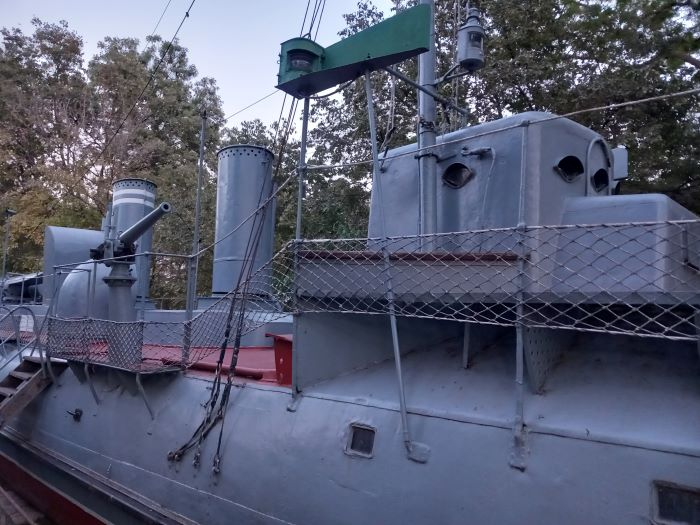
The bridge, funnels and one of the three pounders on the Drazki.
During the Russo-Japanese War in 1904-5 both sides had used torpedo boats extensively, and they had scored some successes. But the hit ratio for torpedos was very low compared to how many were fired, suggesting range and reliability were crucial issues.
At Varna in November 1912, the Bulgarians had no choice but to send out their small flotilla to take on the Turks, and save their city. Dimitar Dobrev–who had served in the Russian Navy and been sunk on a cruiser at Tsushima in 1904–led out the Brave, Stern and Intrepid in the Flying, to intercept the Hamidiye before she could get within range to open fire on Varna. The city and its thousands of people’s fate hung on Dobrev and his men. This would be the first action of the nascent Bulgarian Navy, and they all knew they could not fail.
Details for the French-designed Drazki class torpedo boats.
Just after midnight the Turks were sighted 30 nautical miles off Varna: Hamidiye and two destroyers escorting some merchant ships from Constanta to Constantinople. The Bulgarian flotilla opened up to full speed and attacked in line-ahead, one after the other.
No doubt the Turkish guns opened fire on the attackers, as hunters and prey twisted and turned in the darkness of the calm November night. As well as her big guns, Hamidiye sported six three-pounders able to fire 20 rounds per minute and six more lighter one-pounders that fired several hundred each minute. Her captain claimed to have sunk two of the attackers, but actually only one was hit. Which was pretty poor shooting considering.
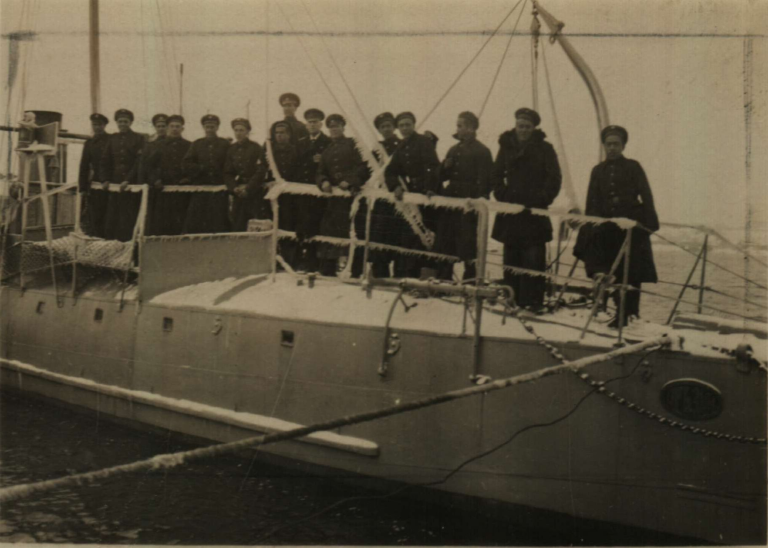
Drazki on the Black Sea in winter.
Dobrev raced in and released his torpedos from 500 metres, before turning sharply to open the range. His ‘fish’ missed. Brave followed but copped a six-inch round which no doubt impeded their concentration, and its torpedos also missed. Stern likewise either did not get close enough or its aim was off, and those torpedos sped off into the yonder.
The last attacker, Intrepid or Drazki in Bulgarian, was commanded by Ensign Georgi Kupov. It was all up to him and his crew. Varna depended on them. If each Bulgarian boat was firing all its three torpedos, then Captain Orbay on Hamidiye had commendably avoided nine so far, and probably fancied his chances at that stage.
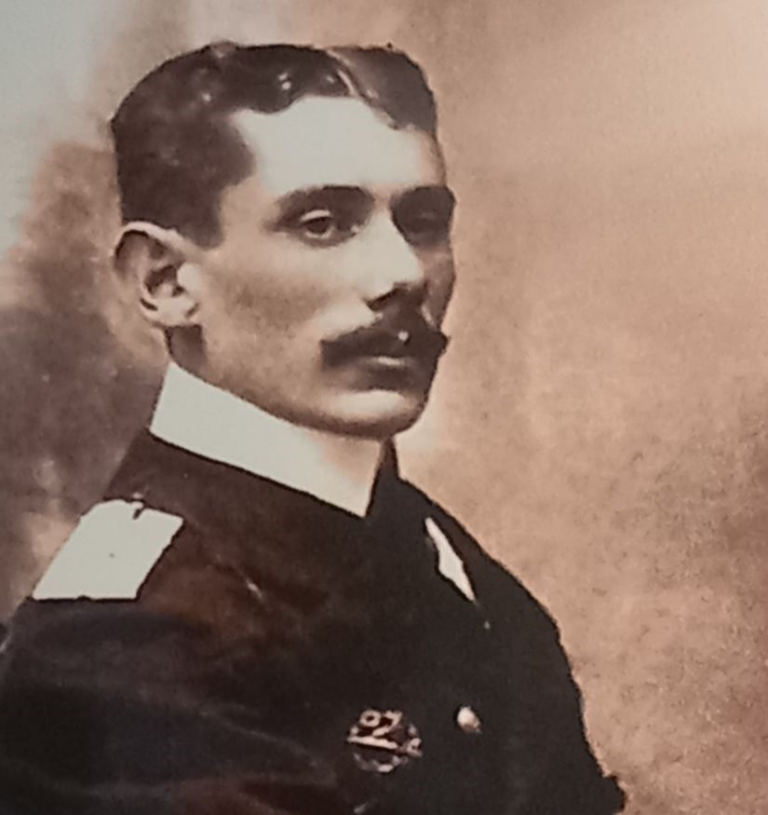
Ensign Georgi Kupov
But Kupov, ignoring the fusillade coming from the cruiser, raced in closer than his colleagues, and at what he claimed was a range of less than 100 metres, loosed his ‘fish’. By rights he and his crew should not have survived without a scratch, but they did. They were the target of two dozen guns at crossbow range, but lived to tell the tale.
Torpedos in 1912 were very slow, probably slower than the cruiser, but at that range, the Bulgarians were in luck. One ‘fish’ hit the Hamidiye punching a big hole in its bow. Eight crew were killed and thirty injured aboard the Turkish ship. There was doubt whether she would see the morning, but her pumps kept up and she withdrew very slowly to the Bosporus, bows almost underwater.
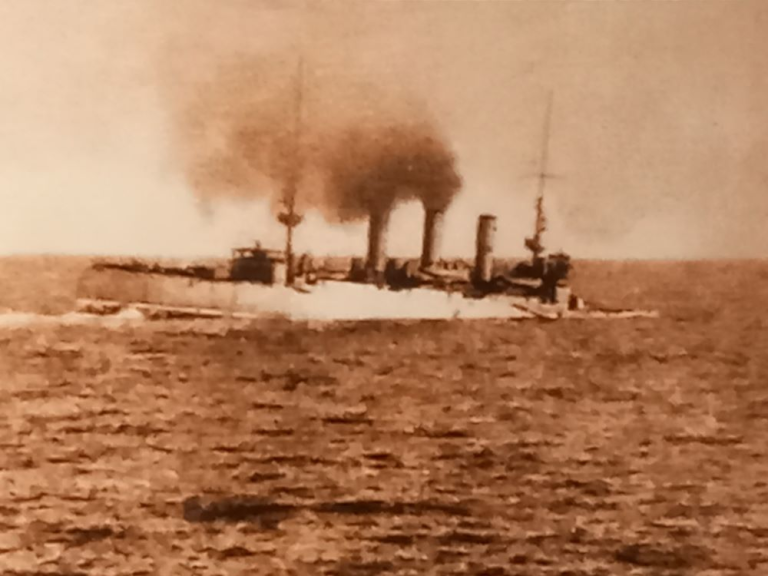
Amazing to have survived. Hamidiye bows underwater next day, steamimg slowly south for the Bosporus and a tug boat.
Bombardment forgotten, the Turkish flagship out of the war for months, Varna saved! No doubt a courageous Ensign Kupov drank some raki that night without reaching for his wallet once.
Hamidiye returned to action after patching up, breaking into the Mediterranean and attacking Greek shipping until the short war wound down. She returned to the Black Sea in WW1, engaging Russian ships several times, and continued in service through WW2. She was only scrapped in 1966.
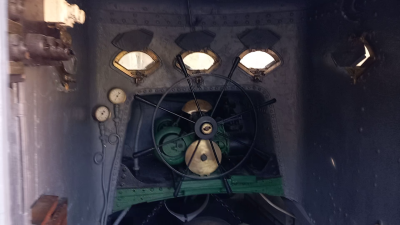
The austere bridge of Drazki, looking forward. It reatins the original controls and navigational instruments.
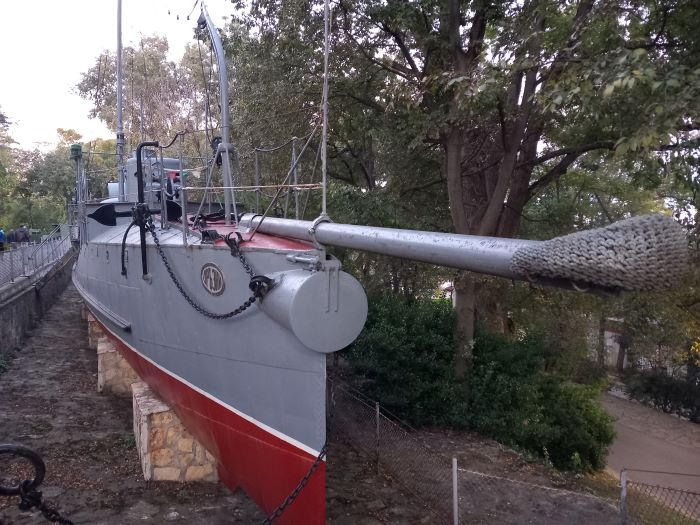
The Bulgarian torpedo boat flotilla also served in WW1 and WW2 where they were relegated to patrol duties, minus one lost to a mine. After over a half century of service, in 1957 the most famous Bulgarian Navy ship ever was preserved as a monument celebrating Kupov and his 1912 victory. Drazki can be seen today, centrepiece of the interesting Naval Museum on the seafront at Varna, looking out over the water where she scored her immortal hit.
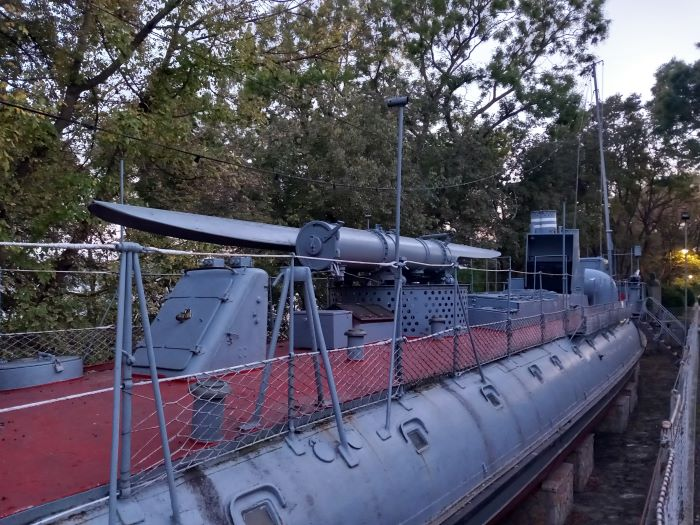
Drazki is a treasure to look around the time-warp that was cutting edge over a century ago. The long, slender hull with her little armoured conning tower and twin funnels. The centreline bow torpedo tube and the two aft tubes on their swivel mounting. A tiny wheelhouse still with the original gauges and navigational instruments. Two little three pounders mounted on the bridge wings. Below, the whole centre of the boat filled with machinery for developing horsepower; in the bow the seamen’s bunks; astern the captain’s cabin; a little cookhouse aft of the second funnel. A real treat.
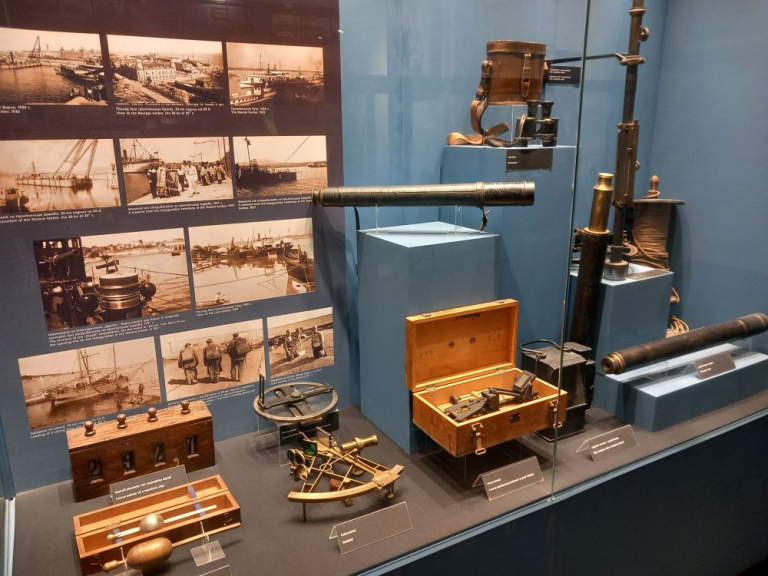
Artefacts on display at Varna Naval Museum include items from Drazki.
Rear deck of Drazki looking forward. The two aft torpedo tubes were on a swivel mounting.
There are not too many hundred-year-old torpedo boats left around, and Drazki is a hero with a good tale to whisper. So, if you ever find yourself in Varna, check her out.