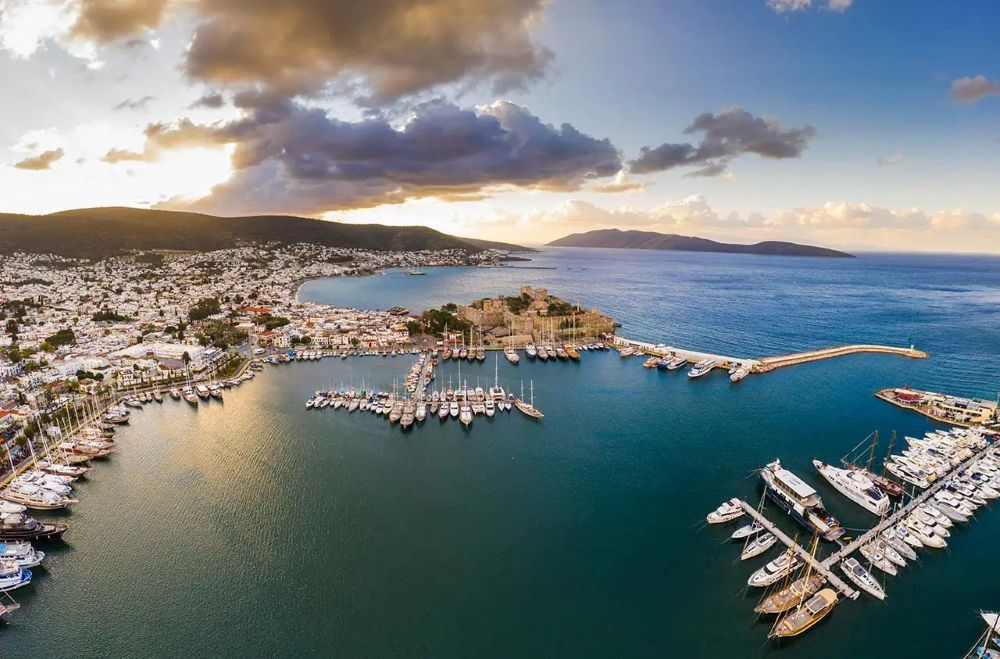
For a small harbour city on the ruggedly beautiful Turkish Aegean coast, Bodrum plays some big cards for visitors.
These days it is a famous summer tourist spot, full of high-end resorts and hosting a fleet of superyachts, charter boats and gulets, the celebrated local cruising yachts, for holiday escapades. Which does however mean unless you like to hob-nob with Russian oligarchs, July and August are probably not the time to visit.
Bodrum does sport a decent old town and of course, pedestrian streets filled with souvenir shops, bars, nightclubs and seafood restaurants. But among these modern services are some much older and quite fascinating distinctions. We’ll get to those in a minute.
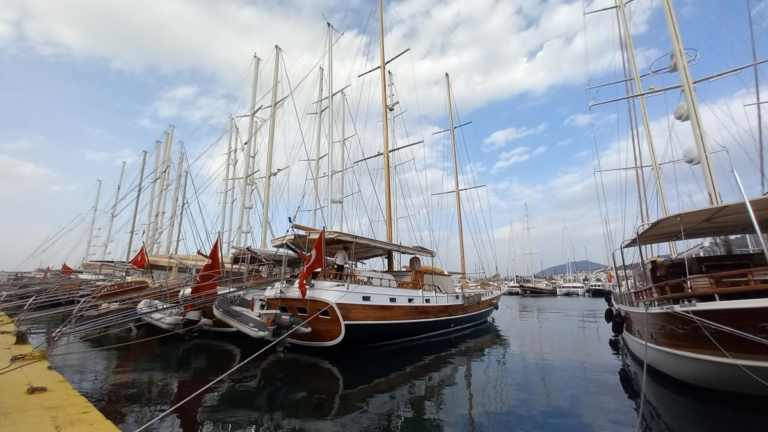
A nice line-up of local gulet cruising yachts along the dock at Bodrum.
With its own international airport, decent autobahns, a network of ferries and a scattering of Greek isles close-by, Bodrum is well connected. Greek Kos is just offshore, and you can easily do a day trip to Rhodes.
And, though there is just rubble as testament to its former grandeur, you can stand on the site of one of the Wonders of the Ancient World!
But for me, the biggest drawcard for Bodrum is its very historic fortress, Bodrum Castle. Once a stronghold of the Knights Hospitaller, it is a place with many stories to whisper. And within the castle there is the bonus of a really superb shipwreck museum displaying thousands of years of artefacts recovered from the surrounding reef-strewn waters.
Let’s dive in to what Bodrum has to offer.
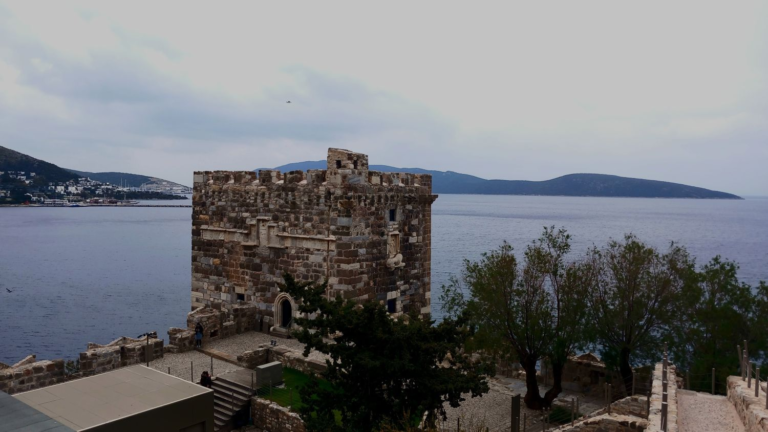
Looking seaward at the English Tower, with Greek Kos Island just offshore.
Not too long ago, Bodrum was a sleepy fishing village no-one had heard of. Now, it’s often called the St Tropez of Turkey, or the Cannes of the Aegean. It draws high-end dilletantes and yachties to its mouth-wateringly pricey resorts, spas, boutiques, marinas and restaurants, and has developed a reputation as the jetsetter capital of the coast.
But its history goes way, way back to when it was known as Halicarnassus, capital of the wealthy kingdom of Caria which thrived for 500-odd years until it was absorbed into the Persian Empire around the sixth century BC. Halicarnassus’ most famous son was the ‘father of history’, Herodotus, whose History is, even today, a very good read.
Another notable Halicarnassan was King Mausolus, who gave us his legendary mausoleum, one of the Wonders of the Ancient World. Its ruins can be found among the white-painted villas of modern Bodrum.
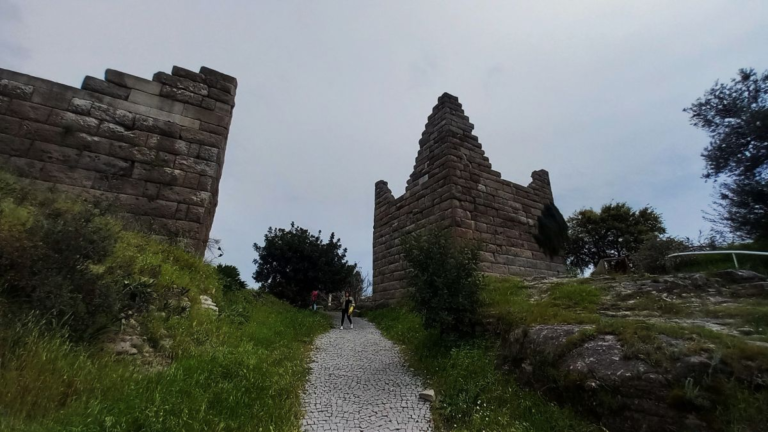
Remains of the impressive Mindos Gate, through which Alexander the Great marched his army after defeating the Persian forces nearly 2400 years ago. It's scale gives you an idea of the powerful ancient walls of Halicarnassus.
A later visitor was Alexander the Great, who stormed in through the still partially extant Mindos Gate, after a short siege before continuing on to conquer the Levant and Egypt, supposedly adopting the Carian Queen Ada as his ‘mother’ (or lover) along the way.
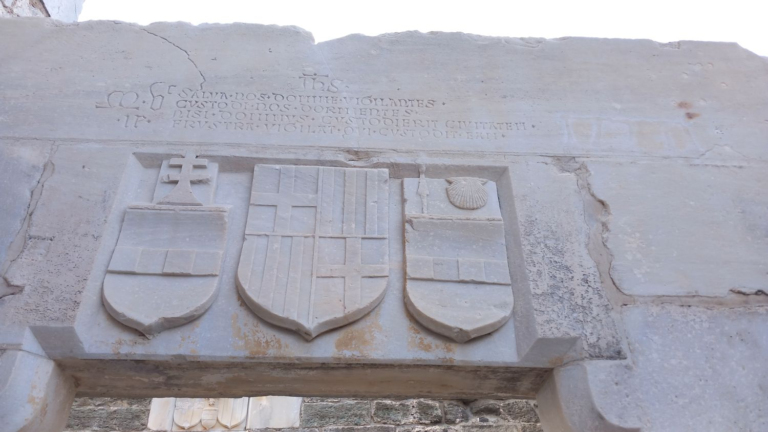
One of the many displays of shields and escutcheons on display in the walls of Bodrum Castle. The white marble is likely from King Mausalus' nearby tomb.
In the early fifteenth century the Catholic military order, the Knights Hospitaller, arrived from their fortress at nearby Rhodes (which they ruled from 1309) to establish a mainland base after losing their castle at Izmir. They chose a small promontory – Zephyrion – that dominated the Halicarnassus harbour where a ruined Seljuk fortification was already sited. The site’s obvious potential for military use had been established perhaps around 1000 BC during the time of the Doric Hexapolis, and is also the likely location of Mausolus’ fortified acropolis (mid-4th century BC). All of which provided the crusaders with enough building materials to raise their castle, construction of which kicked off about 1403.
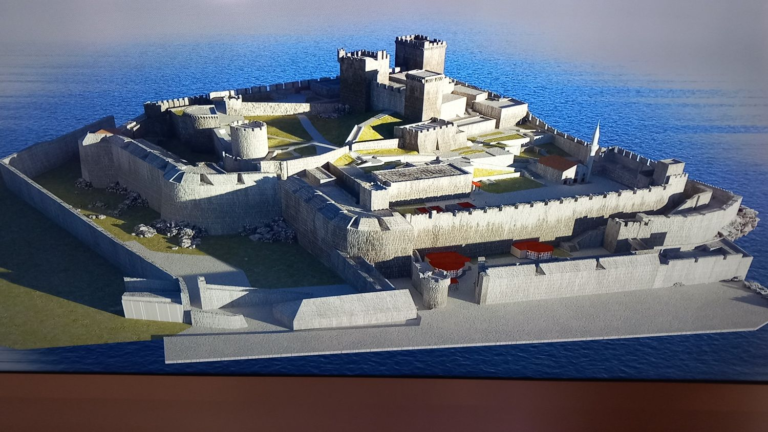
The original, fairly basic design concentrated on defending the northern sector of the tiny peninsula from land attack, and involved walls and a series of four medieval-style towers to defend these walls, as well as two rectangular towers near the highest point of the peninsula. The knight’s naval galleys were envisaged as defending against any sea attack.
A depiction of the Knight's castle from a display on the site. The contrast between the high medieval towers and the lower, more modern embrasures for cannon is apparent. The image highlights the complex land-facing defences, with the English Tower furtherest away.
From this point onwards, and like all Mediterranean fortifications, Bodrum was constantly modified over the years to reflect the evolution of military technology. After Ottoman cannon had shattered the previously impervious walls of not-far-away Constantinople in 1453, the knights looked at their tall, narrow walls, and started building again. With a great deal of urgency. The threat of Ottoman naval attack also required the completion of walls surrounding the entire seaward side. Cisterns were cut into the rock for water supply and new structural additions were needed on the ramparts and towers to allow cannon to be mounted.
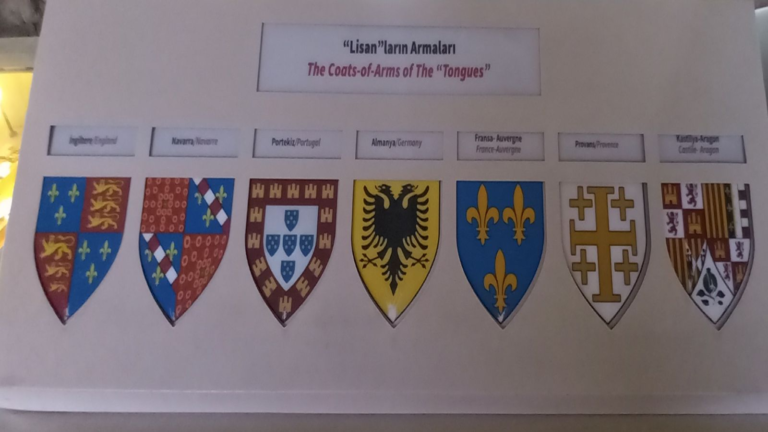
The garrison was generally around 50 knights and one or two hundred Latin mercenaries, with the knights drawn from Spain, France, England, Italy and Germany. These langues of the different nations were given control over a tower and section of the wall, so that today we can see the towers of these five lands.
Crests of the langues that defended Bodrum Castle for over a century; from left, England, Navarre, Portugla, Germany , Auvergne, Provence and Arragon. Being surrounded by Ottoman land and naval forces, with a tenuous supply line to Rhodes meant the fortress was never a coveted posting.
When the Venetians raided the Turkish town, outside the castle walls, in 1472 and the locals mostly fled, this gave the knights access to the ruins of the nearby mausoleum, from where they were able to pillage more stonework to burn for lime and use for new defences, as well as the remaining priceless elaborate carvings and friezes which were placed as decorations at various locations around the castle. Many examples of the mausoleum’s blue limestone, green lava stone and white marble can be seen in the castle today, although the best of the friezes were liberated by the British Museum.
Named St Peter’s Castle, and also known as Petronium, this was later corrupted to give us Bodrum, as the city is now known.
The Ottomans attacked the castle on a number of occasions, but when the Knights of St John on Rhodes surrendered their fortress to Sultan Suleiman in 1523, they also had to give up Bodrum as part of the deal. The Ottomans took over the castle, and today it is of course part of Turkey.
The castle today is a hodgepodge reflecting a range of designers, refurbishments, additions and alterations concocted over several centuries. Visually different designs and materials are clearly evident in most walls that you can see.
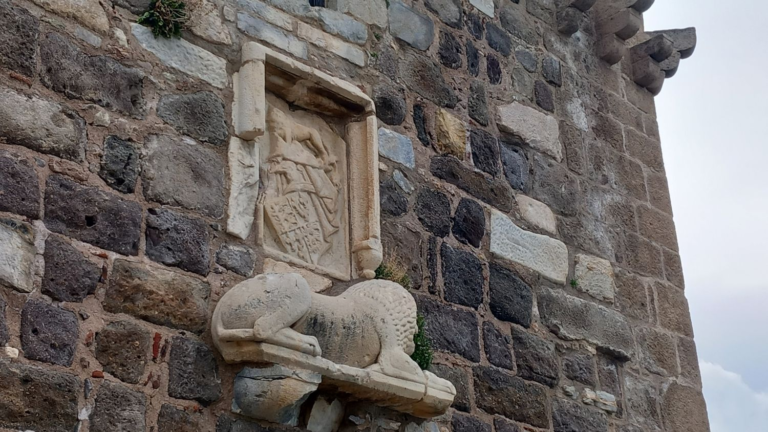
A close-up of details on the English Tower, showing a lion pillaged from the Mausoleum, and above it, the shield of King Henry IV of England, who bore some of the costs of maintaining the tower and its garrison.
One of the most interesting features of the castle today is the great number of shields, escutcheons and coats of arms carved from Mausolus’ white marble placed at various points, indicating rebuilding works and identifying on whose orders they were carried out, and which langue did the work.
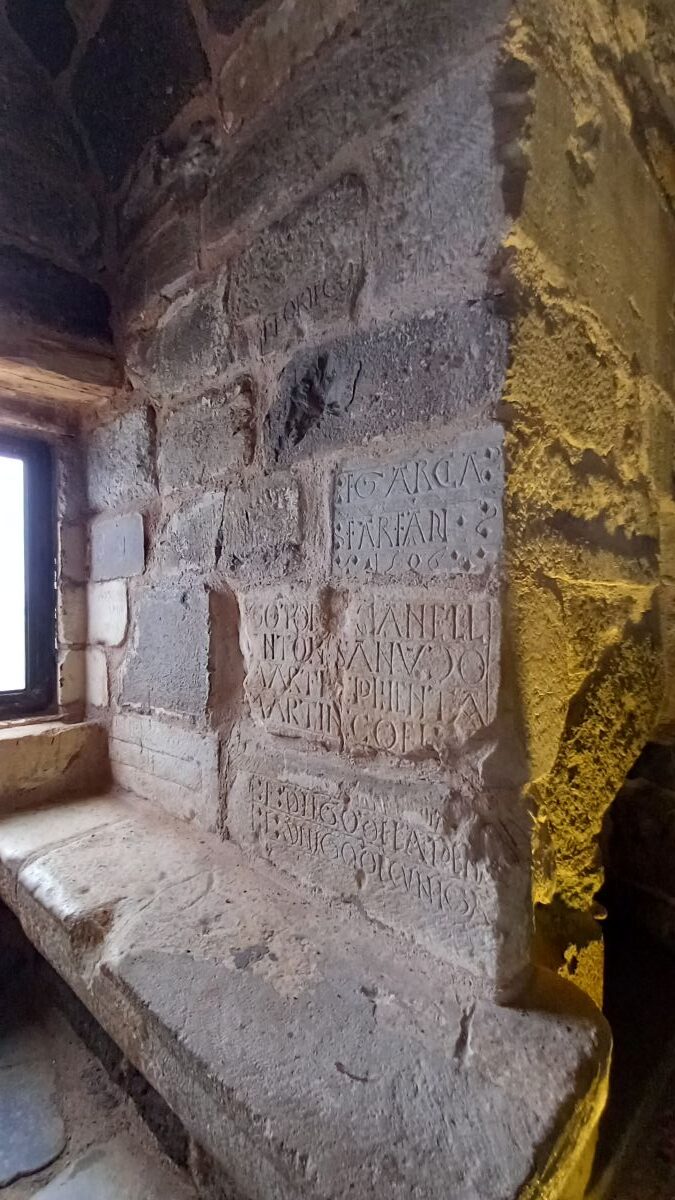
The English Tower is one of the few that is accessible today, and displays a treasure trove of carved coats of arms, a lion from the mausoleum, the shield of Henry IV, and graffiti etched into the stone by bored sentries.
A lookout in the English Tower, with graffiti carved by bored sentries in stone taken from a Wonder of the Ancient World.
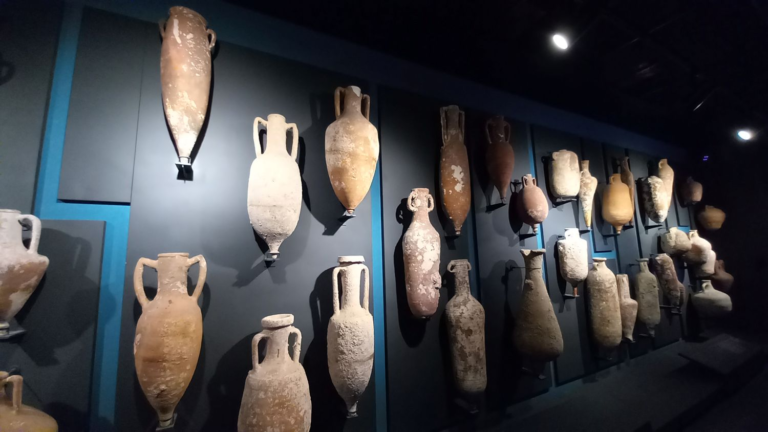
Also a must-see inside the castle grounds are several impressive exhibits from the Museum of Underwater Archaeology which are located in the Italian Tower and some other converted or modern structures. The oldest of the wrecks–all of which met their ends in the waters around Bodrum–is the 14th century BC Uluburun ship which went down off nearby Kos carrying a ton of tin, ten more of copper (which combined to make bronze), as well as glassware and pottery.
A collection of amphora storage vessels recovered from shipwrecks. Marine archeology can confirm what was in the amphora, where it originated and where it was heading by inscriptions on the jars themselves.
The collection of remains from ships of the Hellenic, Mycenean, Byzantine, Roman and Ottoman times and their fascinating cargoes of trade goods, amphorae, ingots and jewellery is really a treat. Considerable effort has gone into the displays and presentations. You wander back through twenty-five centuries of maritime trade through the oft-perilous Aegean waters that you can see stretching before you from the battlements just outside the exhibits. Well worth a look if you have the least inking for nautical archaeology.
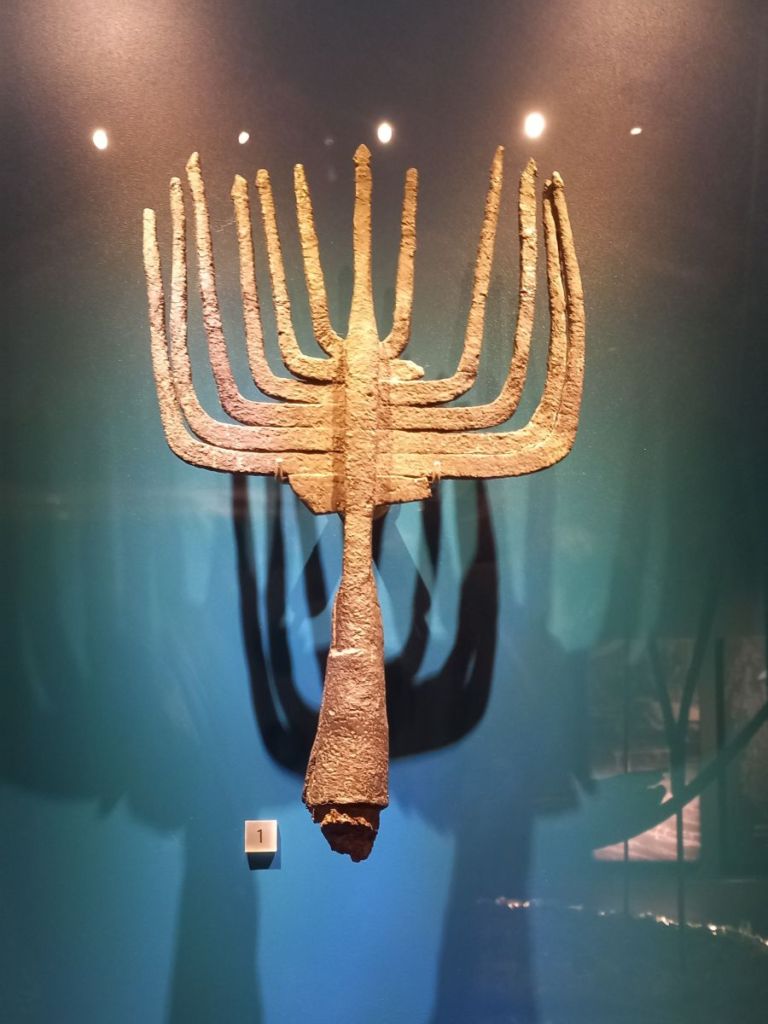
A stunning bronze harpoon on display at Bodrum Museum, recovered from the seabed after centuries underwater. Just one of the enormous range of artefacts from a series of wrecks found in the perilous waters offshore from Bodrum.
So, all in all, Bodrum has a stack of activities to keep you busy for a good few days. From the dominant crusader castle, the shipwreck museum and the mildly evocative ruins of the Mausoleum, you can add a tipple at a local winery, a sticky-beak along the gulets and superyachts of the marina, a wander through the markets of the old town, pass through the Myndos Gate in Alexander’s footsteps or scuba dive on a shipwreck yourself. You could also do a day trip to a Greek island, any number of boat tours near and far, and always there is the chance to indulge in fine food at a table by the harbour, while you soak up centuries of history and atmosphere. Bodrum is definitely worth a look!