
Lists of Wonders of the World go back a very long time, all the way to the era of Herodotus in the fifth century BC (this Greek historian and geographer, known as the ‘father of history’, was actually born at Halicarnassus, site of one of our Wonders).
But the generally accepted modern list of the Seven Wonders of the Ancient World comes down to us from Antipater of Sidon, a Greek poet who lived around 100 BC.
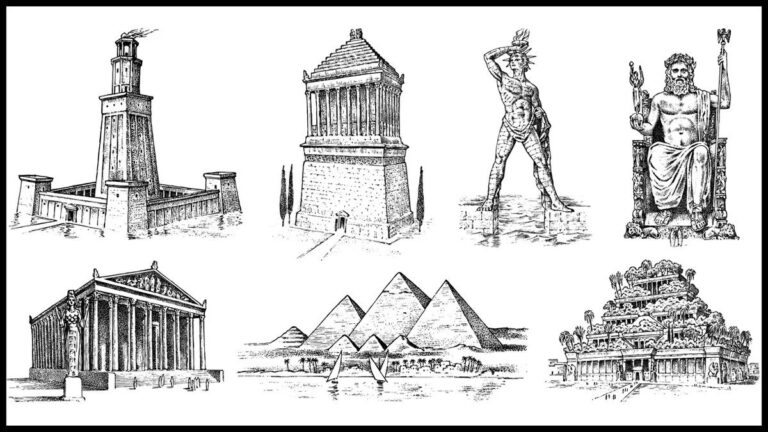
His list–in chronological order–starts with the great Pyramid of the Pharaohs at Giza, Egypt from 25 centuries before Christ; then to the Hanging Gardens of Babylon; the Temple of Artemis at Ephesus; the Statue of Zeus at Olympia in Greece; the Mausoleum at Halicarnassus, in Turkey; the Colossus of Rhodes; and lastly, the Lighthouse of Alexandria.
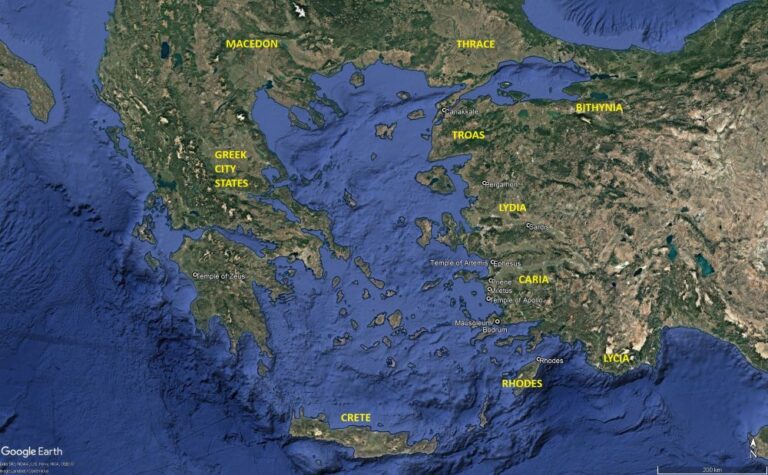
In terms of modern borders, two are in Egypt, two in Greece, two in Turkey and one in Iraq. The only Wonder still standing is the Pyramid at Giza. All the others succumbed, mostly to earthquakes, long ago. Apart from the Pyramid, the last two standing were the Lighthouse and the Mausoleum which were both toppled around the fourteenth century.
Historians know the least about the Hanging Gardens. It is not even clear where they were located, and if actually, they ever existed. Strike finding them off the list.
Zeus, king of the Gods, whose great statue at Mount Olympus was pilfered by the Byzantines, or alternately destroyed by fire or earthquake around the fourth century, is also lost without trace, though the ruins of the temple which housed mighty Zeus can still be seen at Olympia.
The Lighthouse at Alexandria stood for a thousand years, most of that as the largest man-made non-pyramid structure in the world, but toppled into the sea after a three-century series of earthquakes ending around 1300 AD. The ruins of the structure have been discovered, underwater in the Bay of Alexandria, and you can dive on them, if you feel inclined.

That leaves us with three Wonders closely geographically spaced which we will now visit; the Mausoleum at modern Bodrum in Turkey; the Temple of Artemis at Ephesus, nearby in Turkey; and just a short hope across the blue Aegean, Rhodes, the site of the incredible statue of the sun-God Helios, known as the Colossus of Rhodes.
Of the last, there are no remains at all, and even the precise location on Rhodes is a subject of debate. Of the temple and the mausoleum, the sites are clearly identified, but sadly, only scattered remnants survive to give an idea of the once glorious majesty of these ancient monuments to gods and classical rulers.
TEMPLE OF ARTEMIS AT EPHESUS
If we progress by age once more, the Temple is the oldest of our three. More properly described as a temple to Diana, a mysterious goddess of the Lydians, this structure was rebuilt several times after first being raised around 700 BC.
The Lydians were a wealthy pre-Greek Anatolian tribe inhabiting what is now western Turkey, with their capital at Sardis, nearby to Ephesus. Initially a thriving port and temple city independent of Lydia, Ephesus was absorbed by Lydian ruler Croesus (from the saying ‘as rich as Croesus’) at the peak of the Lydian empire, around the mid-sixth century BC.
On the site of an earlier temple dating back at least two centuries but destroyed by floods, Croesus funded a new magnificent temple to Diana, and commissioned an architect from Crete, Chersiphron, to build it.
Chersiphon helped by his son, Metagenes certainly earnt their commission. The scale of the engineering required presented such a challenge that the father considered suicide when unable to devise a method to lift the 24-tonne entry lintel atop the 13-metre-high columns. Next morning, miraculously, the goddess had raised the 8.5-metre-long stone into place. So the legend goes!
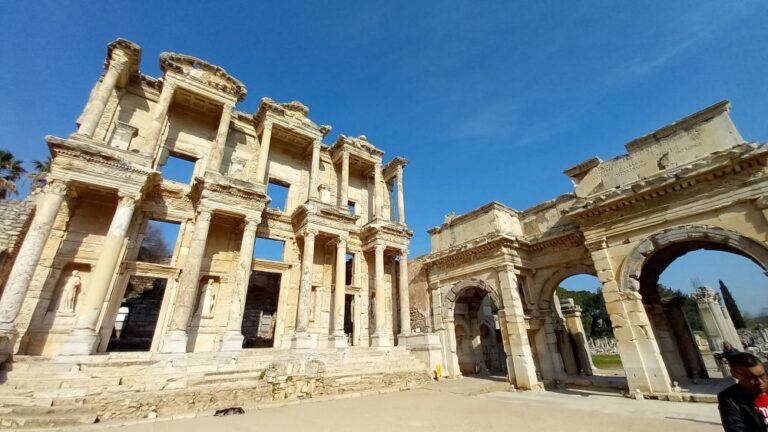
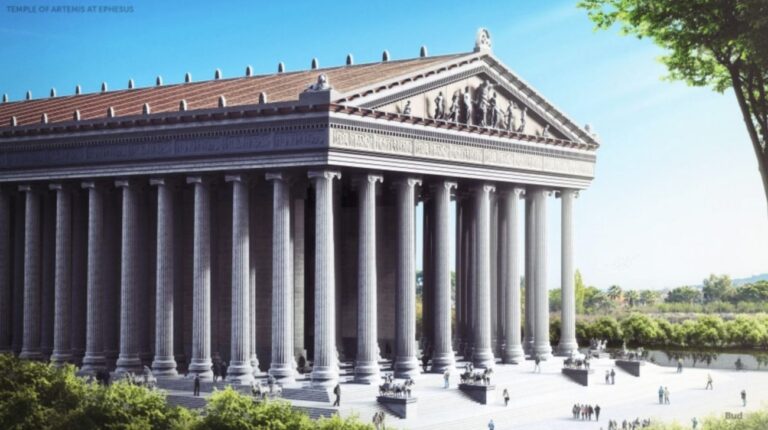
Twice as large as the surviving Parthenon in Athens, the incredible structure was supposedly the first temple built completely of marble, the first double colonnaded temple, and was as long as two Olympic swimming pools and one wide (110 x 55 metres). There were 127 fluted columns capped with architraves nearly nine metres long, weighing 40 tonnes each.
The quarry for the marble was 11 km away, and Metagenes had to design a timber wheeled frame around each end of the giant blocks so they could be rolled as oxen teams hauled them to the temple site.
Alas, the magnificent temple to the goddess of hunting and wild animals stood for just two centuries before its destruction by a pyromaniac seeking immortality. Legend has it that Alexander the Great was born that same night just a four-day sail away in Macedonia; Artemis (also goddess of childbirth) so occupied with his birth she neglected to protect her own temple.
Alexander’s story crosses paths with all the Ancient Wonders of the World. As primarily a celebration of the Hellenic world, the seven wonders all stood in lands he conquered. After his first victory in (334 BC) against the Persians–who by then ruled the Lydian lands–Alexander paraded his army in front of the ruins of the burnt wreckage and offered to rebuild the temple.
The proud Ephesians declined, raising funds themselves to bring the third, and grandest, iteration of the temple, in Hellenic style, to completion at the time of Alexander’s death in 323 BC. This temple was higher, larger and much more embellished, with elaborate relief carvings, magnificent column-topping capitals, and a gold and silver decorated ebony statue of the goddess herself.
The sad end for the temple, once Lydian, next Persian, then Greek, and finally Roman, came with an earthquake in 262 AD. Rampaging Goths completed the pillaging a few years later. By 1200 AD the harbour at nearby Ephesus was silted up, and the site of the temple itself covered in a thick layer of mud, not to be rediscovered until found-and plundered–by British researchers in the nineteenth century.
THE TEMPLE RUINS TODAY
Today the temple site can be easily reached from the magnificent ruins of Ephesus, just two km away. The major city of Izmir–old Smyrna–with its international airport, is an hour’s drive along good motorways and normally the base for exploring the region, with also includes spectacular Pergamon.
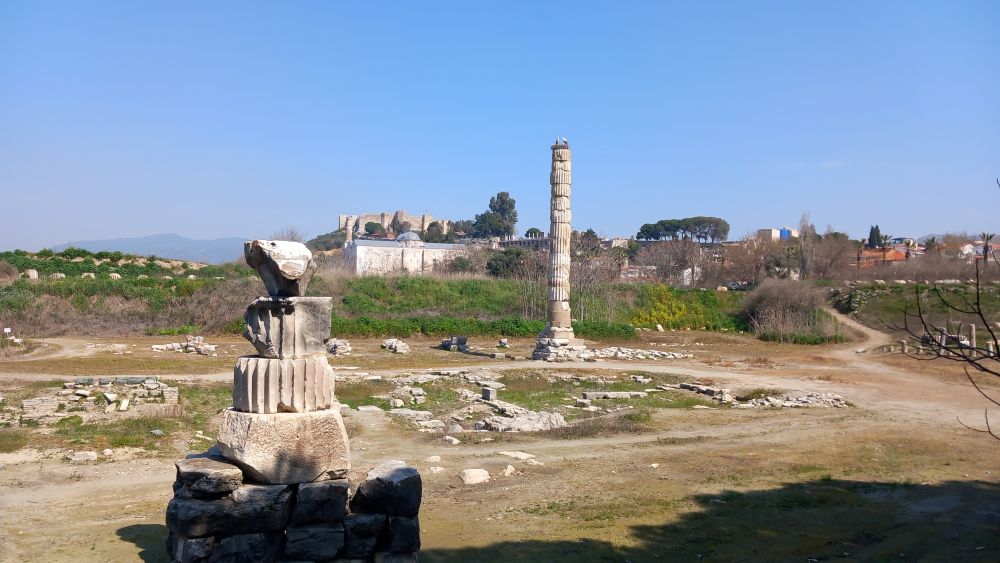
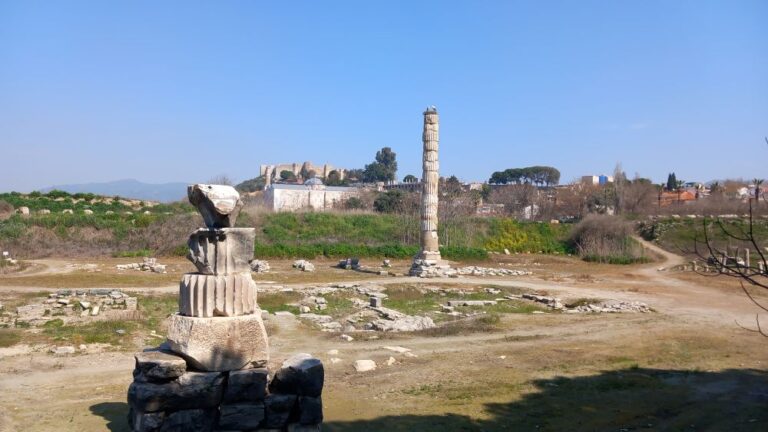
To be honest, for a Wonder of the World, it is a little disappointing. The temple once stood on a marble pedestal several metres proud of the surrounding flagstones, but even this has long disappeared. The site is a swamp nowadays, bestrewn by weeds, mangy dogs and spruikers peddling faded postcards. No goddess in sight. Tour buses churn the dust as groups disgorge, impatient only for a quick selfie. There is no romance, no enduring link with the fabulous ancient temple.
Of the 127 soaring columns that graced the shrine, just one composite has been reconstructed to give an idea of the scale of the structure. The footprint needs to be imagined. The towering, gilded gables, the massive capital friezes, the lion-headed waterspouts are nowhere to be seen.
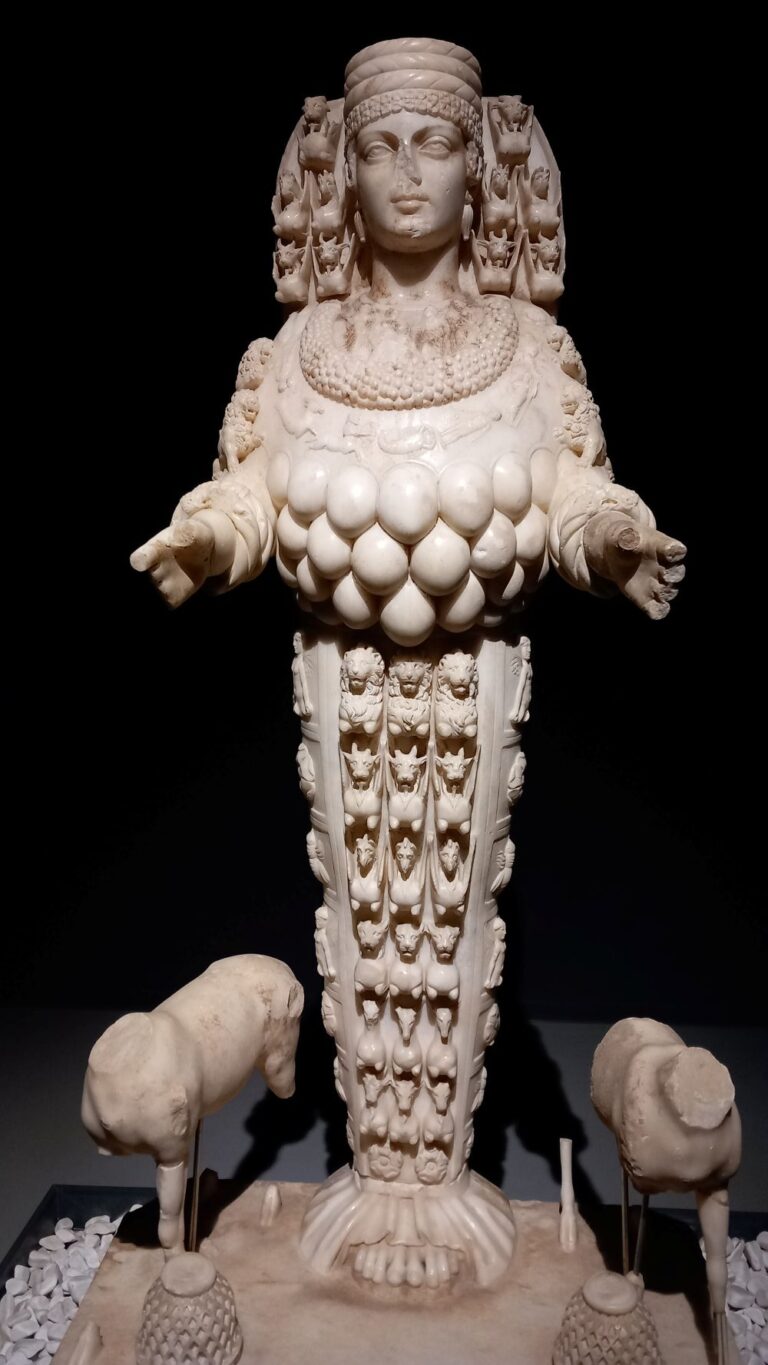
Not far away though, the Ephesus Archaeological Museum is worth a look. If only for the visual reconstructions of the temple and the superb statue of the goddess herself, amazingly decorated, most prominently with a chest-full of globules that are alternately described as milk-giving breasts or bull’s testicles.
For some further icons pillaged from the temple site, you can check out the Ephesus Room at the British museum, or the Ephesus Museum in Vienna.
THE MAUSOLEUM AT HALICARNASSOS
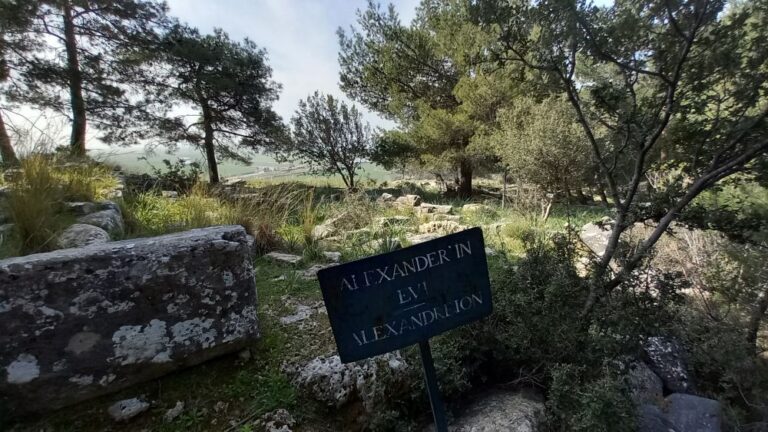
When Alexander the Great invaded modern Turkey to take on the mighty Persian Empire in 334 BC, he started by crossing the Dardanelles into Asia and paying homage to Achilles at Troy. He went on to defeat the first army the Persians threw against him at Granicus, then captured the royal capital of Sardis. From there, he stopped at Ephesus, offering to rebuild Artemis’ temple, proceeding onwards to Priene which submitted to him peacefully, and to Miletus which did not. After storming Miletus, he marched south to the still impressive shrine to Apollo at Didyma. The sacred spring had not flowed for nearly two centuries, but started again with Alexander’s visit, so the legend has it.
His next target was Halicarnassus, a major Persian base, a powerful fortress and site of an existing Wonder of the Ancient World.
Neighbouring ancient Lydia to the south was the province of Caria. This too was a pre-Hellenic, pre-Turkic kingdom mentioned by Homer and in the Bible. The Carians fought with Troy against the Greeks in the Trojan War.
Strategically placed on the sailing trade routes, Caria was a wealthy land. Then as now, it sported verdant plains with rich soil supporting a large population, and also plentiful mines and quarries of marble running through the scattered mountain ridges.
Back in the fourth century BC, Caria was a satrapy of the Persian Empire under a king named Mausolus. Like most kings of the time, he enjoyed a little pillaging of his neighbours, which at one time took him into Lycia to the east. He was so impressed by the burial tombs of the Lycian rulers–the Xanthos Tombs–that when he built his new glittering capital at Halicarnassus (modern Bodrum), he planned an even more spectacular tomb for himself, in advance of his passing.
The style would blend Egyptian, Greek and Carian features and considerably outdo all other tombs then known. A Greek architect from nearby Paros, and a Carian who had modelled Priene were engaged to design the incredible structure, and the most famous sculpturers of the ancient world made enormous friezes and larger-than-life sculptures to adorn the stepped sides of the tomb. This Wonder was as renowned for its decoration as its structure.
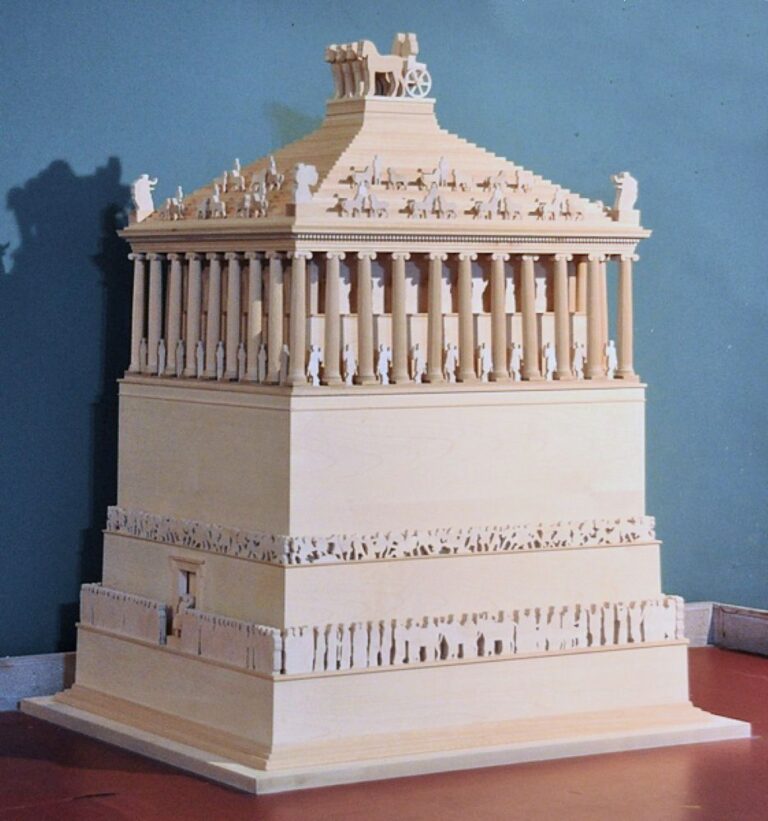
The base was 38 x 32 metres and twenty metres high. Atop that podium stood 36 Ionic columns twelve metres tall. Above that towered a pyramid of 24 steps reaching up to the heavens. And riding on the pyramid’s peak was Mausolus etched in stone racing a four-horse chariot, six metres high. The entire structure was faced with white marble and blue limestone, with a core of green volcanic slabs. The tomb itself was built into the base of the podium, protected from grave-robbers by enormous marble doors.
According to ancient accounts, it was a spectacular monument, a statement of power and wealth, fit for more than just a king. Mausolus was interred in his pre-built tomb just 19 years before Alexander rampaged into the city.
Alexander was no doubt impressed, perhaps even envious, of the magnificent monument after successfully completing his very first siege and entering Halicarnassus in victory through the Myndos Gate.
And there the mausoleum stood for centuries through Persian, Greek and Roman rule, by then still an impressive testament to a never-forgotten ruler who gave his name to all impressive funerary edifices, mausoleums. It was noted as still extant in the twelfth century, but when the Knights of St John arrived to build a castle at Bodrum from nearby Rhodes in 1402, it was in ruins, probably from an earthquake.
WHAT REMAINS?
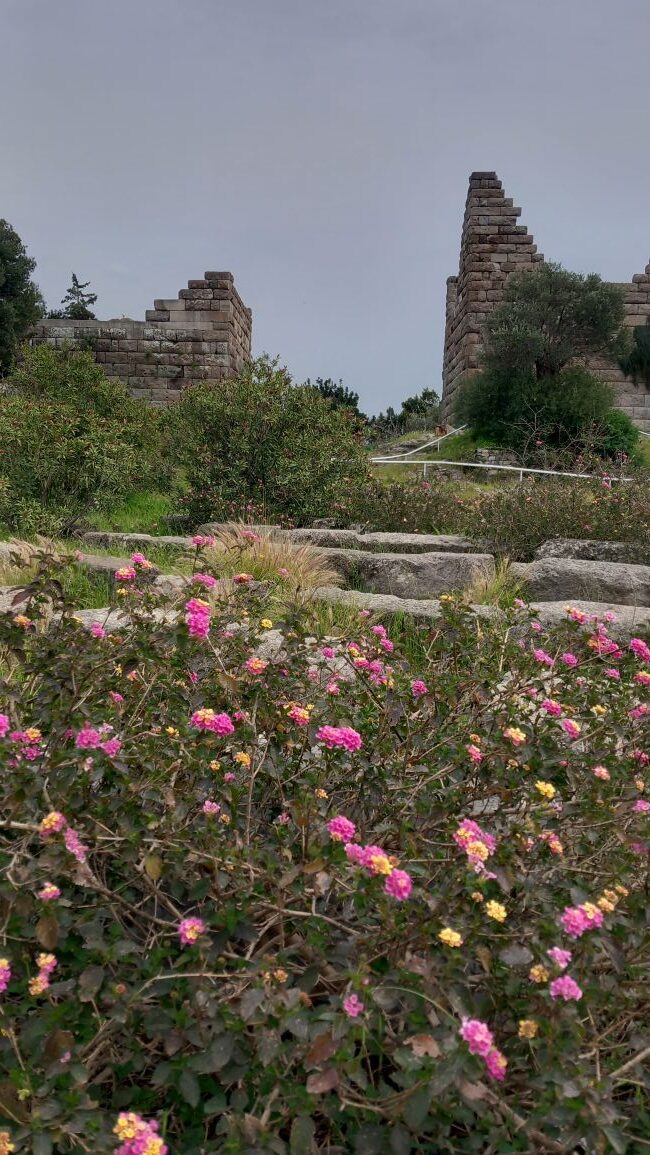
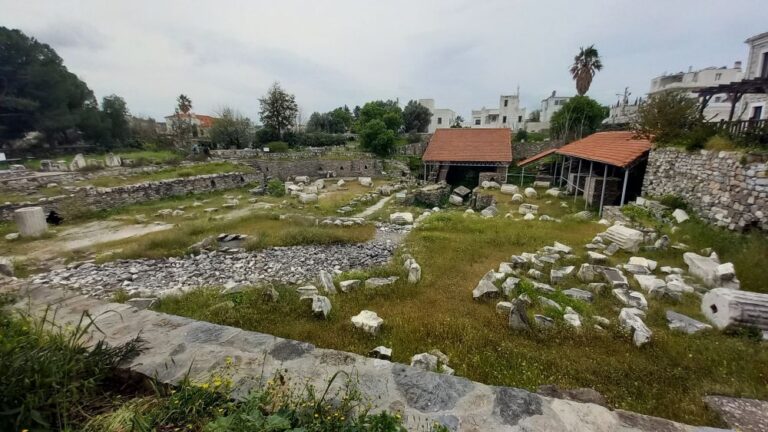
Just 200 metres from Bodrum harbour and one kilometre from the castle of the Knights on the promontory, the scattered remains of Mausolus’ mighty tomb lie among the boxy white villas of the modern city.
Though little remains, it is more atmospheric than Artemis’ Temple, and you can sit on one of the great column fragments from the colonnade, ignoring the modern city hemming you in, and dream up visions of a soaring, glittering marble tribute to an ancient ruler who, with this tomb, did achieve immortality.
A small but fascinating museum on the site provides some additional details of the scale of the structure, modern excavations, and myths and legends surrounding the wonder.
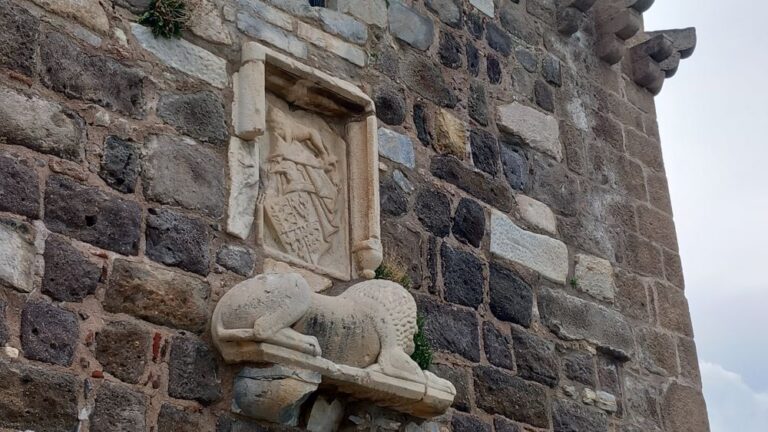
In 1522, when the Knights at Bodrum had already stood in their castle for over a century, the threat of Ottoman attack bade them strengthen their walls. Southern Turkey was a pirate-infested coastline, and they rarely ventured outside the castle ramparts, always resupplied by way of the sea.
Desperate for slabs of stone and lime for raising new bastions, they sent work parties to scour the town for materials and came across what remained of the great tomb–at this stage only the structure’s base plinths of faded marble.
A French knight takes up the story:
We found certain steps of white marble, raised in the form of a terrace in the middle of a field near the port…and therefore pulled down and took away these marble steps, and finding the stone good, proceeded, having destroyed the little masonry remaining above the ground, to dig lower down in the hope of finding more.
After four or five days, having laid bare a great space, one afternoon they saw an opening as to a cellar. They let themselves down through this opening and found it led to a fine large apartment, ornamented all round with columns of marble, with their bases, capitals, architrave, frieze and cornices, engraved and sculptured in half-relief.
The space between the columns was lined with slabs and bands of marbles of different colours, ornamented with mouldings and sculptures, in harmony with the rest of the work, and inserted in the white ground of the wall, where battle scenes were sculptured in relief.
Having at first admired these works, and entertained their fancy with the singularity of the sculptures, they pulled it to pieces, and broke up the whole of it, applying it to the same purpose as the rest (ie Building materials).
Besides this apartment they found afterwards a very low door which led into another apartment, like an antechamber, where was a sepulchre with its sarcophagus and tympanum-shaped lid of white marble, very beautiful and of marvellous lustre. This sepulchre, for want of time, they did not open, the retreat (nightly recall to the castle) having been sounded.
They day after, when they returned, they found the tomb opened, and the earth all round strewn with fragments of cloth of gold, and spangles of the same metal, which made them suppose that the pirates, having some inkling of what had been discovered, had visited the place during the night, and removed the lid of the sepulchre. It is supposed that they discovered much treasure.
So Turkish grave-robber pirates beat French grave-robber knights to the riches of Mausolus’ tomb five hundred years ago. At least the French pillagers wrote shamelessly about their plundering though either party was clearly happy to destroy that enduring 16-century old vault that had survived earthquakes and plunderers down through time despite losing the upper magnificence of the original mausoleum.
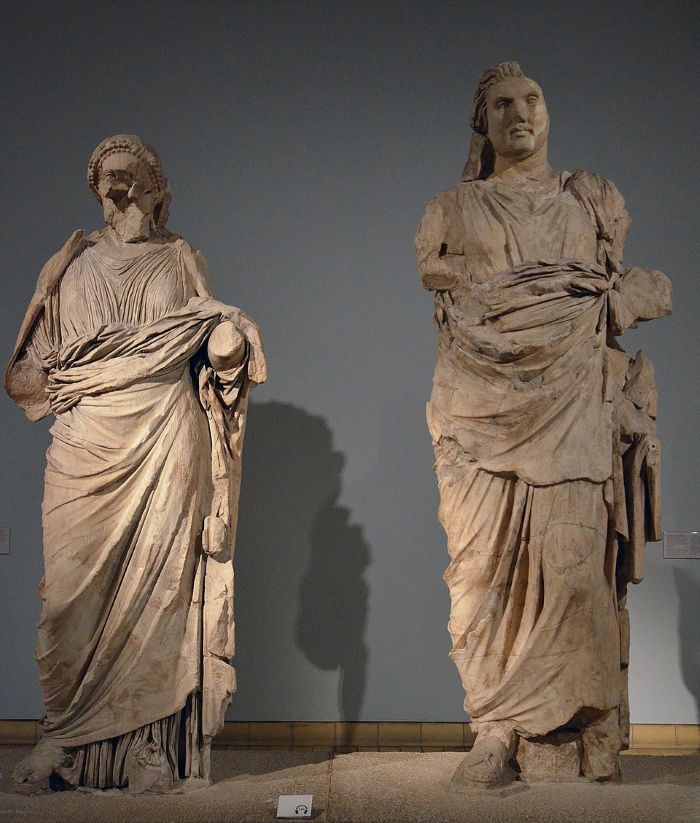
Of course, later imperial pillaging has placed many impressive remnants, including statues of Mausolus and his wife-sister Artemesia in–yes, you guessed it, the British Museum. And some of the marble and limestone blocks are clearly evident in the crusader castle on the point. A sad end for a Wonder. Perhaps Erdogan will rebuild it as his own tomb?
COLOSSUS OF RHODES
From Bodrum harbour, it is a day’s sail south to the Greek island of Rhodes, site of our last wonder. Of which, there are, sadly no remains. And while we know pretty well what Artemis’ Temple and Mausolus’ Mausoleum would have looked like, unfortunately, of the appearance of the Colossus of Rhodes we know little, except its stunning scale.
Rhodes was a crucial maritime trading port well sited between Greece, Asia Minor, the Levant and Egypt. Supposedly created by union of sun-god Apollo and his wife, the nymph Rodos, at one stage it formed part of the Doric League with Halicarnassus. Later, it was Persian, and for a time ruled by Mausolus.
Again, there is a link to Alexander. Rhodes became part of his empire when he defeated the Persians, ending the Achaemenid Dynasty in 333 BC. When he died a decade later in Babylon, his generals divided the empire between them and soon began clashing with each other in the Diadochi Wars. Antigonas-the-one-eyed ruled Anatolia and took on Ptolemy who ruled Egypt.
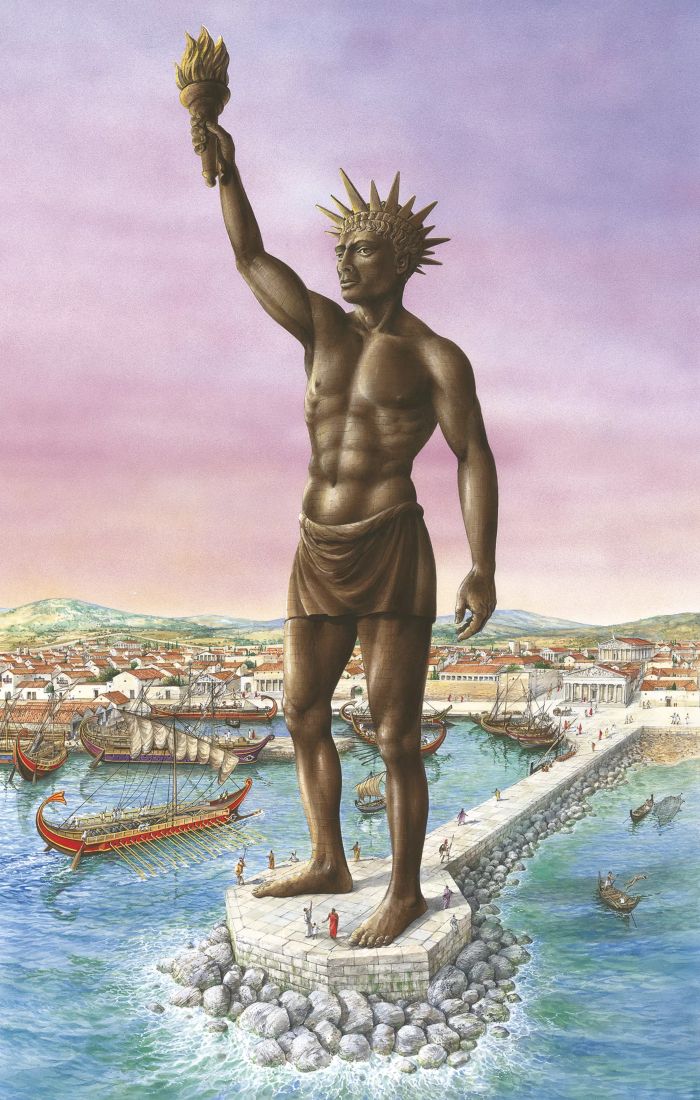
Rhodes was caught in the middle, and was invaded by Antigonas’ son Demetrius, who besieged the main city–also Rhodes–unsuccessfully for a full year. He left behind some sophisticated siege equipment which the Rhodians sold and used the funds to commission a bronze statue of Helios 33 metres tall. The god’s fingers were reputed to be larger than most contemporary statues!
In medieval times, one Italian wag suggested the great effigy straddled the harbour entrance, feet a structurally impossible 130 metres apart. Many modern depictions of the Colossus continue to show this erroneous stance, but the enormous bronze wrapped, iron-framed structure could not have stood any way but feet together and arms straight up or by the side. Additionally, the scaffolding required to support the construction would have closed the harbour entrance for over a decade.
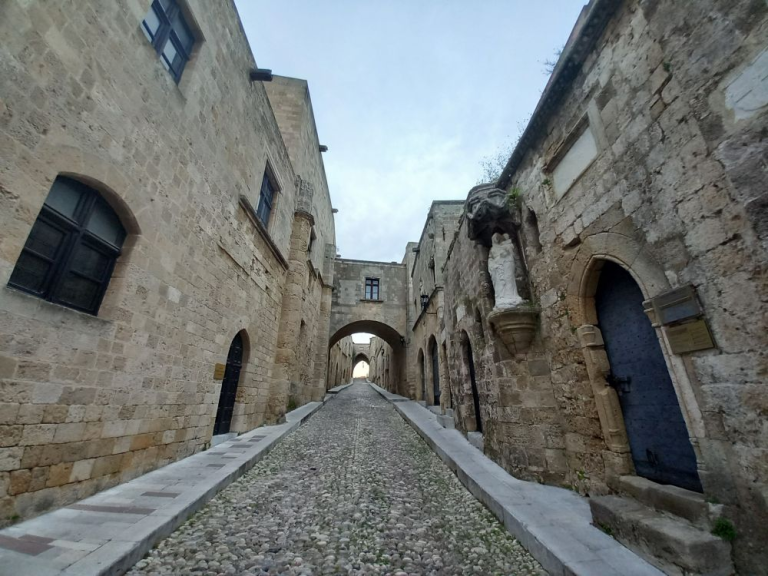
It is likely that the location was either on the highest point of the city, near the ruins of the acropolis, or at an elevated point along the Avenue of the Knights. Astonishingly, rather than being joined together piece by offsite-manufactured piece, the statue was built by being cast in situ, with an earthen mound encasing–and shrouding–the figure, and acting as a mould for the bronze casting process. All this took twelve years to complete (in 282 BC), with the designer, a local talent named Chares, not seeing the results of his work until the final bronze section was poured and the mound stripped away.
By all ancient accounts it truly was a Wonder, sunlight from the sun-God reflecting off the burnished bronze during the day, and the torch shining as a beacon to mariners during the night. If it was sited on Monte Smith, high point above the town, the torch would have been visible for over 65 kilometres.
Alas, it stood for just fifty or so years before being toppled by an earthquake. Even then the fallen wreckage was still venerated for another 800 odd years before it was melted down and sold for scrap by Arab raiders in the seventh century. Plans to rebuild the great Wonder have so far come to nothing.
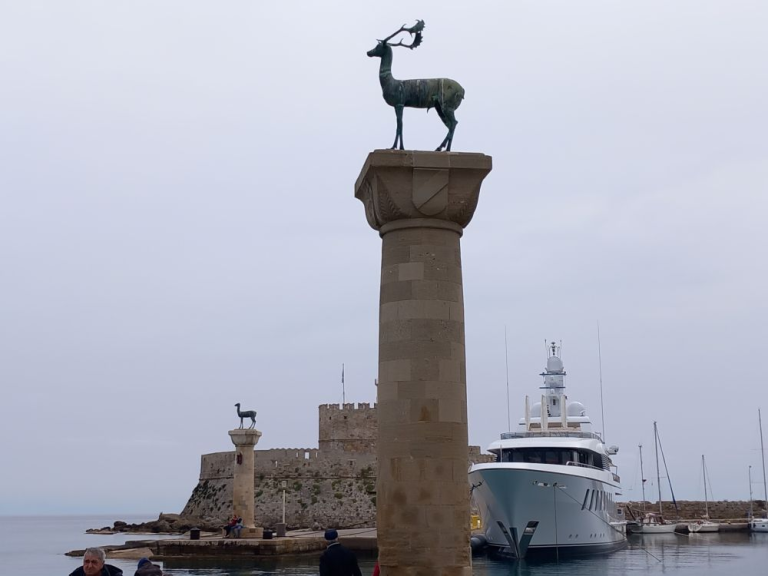
But if you are ever in Rhodes, no doubt you will check out the entrance to Mandraki harbour, where the deer statues stand, one on each side–incorrectly assumed to have been the site of Helios’ feet. You will also no doubt walk up the Avenue of the Knights, so don’t miss the madrasa at the top, opposite the Palace of the Grand Master, also a possible location of the statues base, and the palace itself is too a conceivable location.
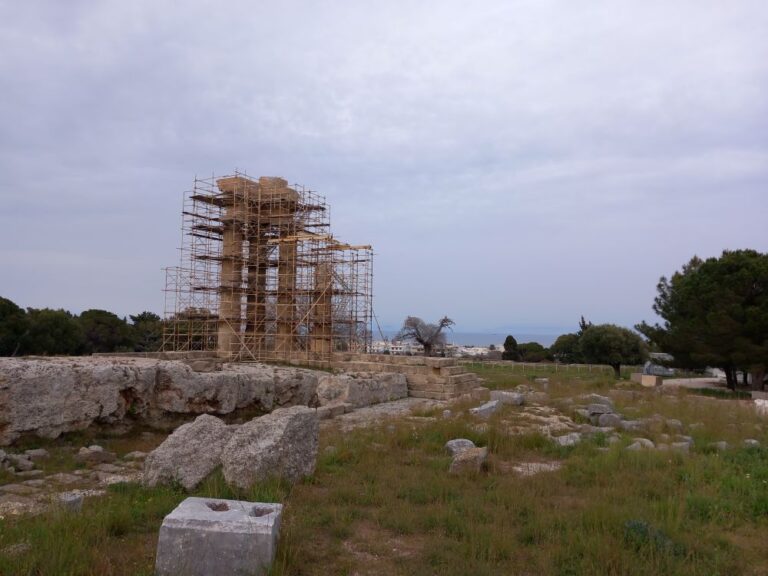
Lastly, wander upwards through the narrow busy streets past the old city and the ancient stadium, and stand atop the ruins of the acropolis, and look down at the glinting harbours far below. Think of a great bronze monument standing as high as a ten-storey building looming above you, shading you from the summer heat of the sun God, Helios. What a sight it would have been. A Wonder.