Adding steel plate to major warships to stop shells penetrating began in 1860 and carried on until the Second World War ended. Such vessels–frigates, cruisers and battleships–were known in the trade as armoured ships.
The need for armour on warships emerged as timber hulls transitioned to iron during the first half of the nineteenth century. The first ocean-going iron ship was the liner SS Great Britain built in 1843. And she can be seen today, restored in all her style, at Bristol, where she was built. The first iron warship was built in the same year; the US frigate Princeton.
Thick oak or teak hulls had been surprisingly effective at stopping cannonballs except at very close range, but the advent of rifled explosive shells mid-century made timber ships extremely vulnerable. Iron plating over timber was the short-term answer.
The first real armoured ship was the French Gloire built in 1860. Her timber hull sported a 12 cm thick vertical belt of iron armour set on 43 cm of teak. The best modern cannons fired at 20 metres could not penetrate it, making the ship impervious to all other warships of its day.
Today, six fascinating armoured ships from the early era of such vessels survive for inspection around the world. Between them they witnessed epic sea battles, clashes of empires, civil wars and revolutions. They lived through intriguing engagements and the fast march of technology. Armour, weaponry and propulsion systems evolved with incredible speed during their careers. And all of them came horribly close to being discarded, before lady luck allowed them to live on with the grace they deserve.
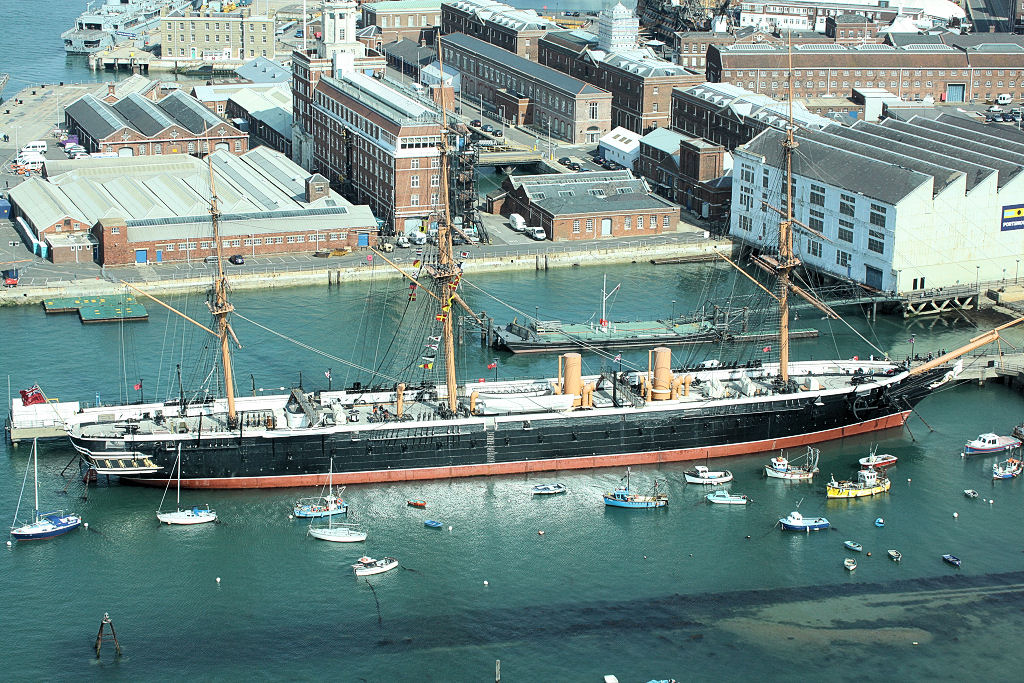
Royal Navy armoured frigate HMS WARRIOR
The threat of the Gloire greatly alarmed Britain, as its entire fleet was outclassed. Quickly, the Royal Navy designed and built the Warrior in reply. At 9000 tons, the iron-hulled Warrior was twice as large as the French ship and a much more powerful vessel; faster, carrying a heavier armament and with better armour. She sported fourteen great guns firing 110 pound shot or shell–when the standard weapon at the time was a 32 pounder–as well as two dozen more 68 pounders.
No contemporary warship could withstand fire from such a battery of guns, and her iron wrapped teak armoured sides could resist any modern cannon fire. She was as close to omnipotent as any warship ever built.
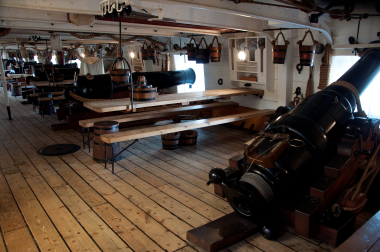
A two-cylinder steam engine produced nearly six thousand horsepower, giving the armoured frigate a top speed of 14 knots. She had a single shaft hooked up to a seven-metre diameter propeller but still carried a full sailing rig–which was what was generally used when at sea. A thousand tons of Welsh steaming coal gave her a range, under power, of two thousand nautical miles.
Though she was the world’s most powerful warship when commissioned in 1861, the pace of technological change meant she was quickly obsolete. Newer battleships carried their guns in rotating turrets and masts with sailing rigs were no longer fitted, allowing the guns much greater fields of fire.
Warrior was relegated to a guardship in 1881 and struck off the Navy list in 1900. Ignominious decades as a school ship, storage hulk and eventually as a refuelling jetty at Pembroke in Wales followed. When the refuelling base closed in 1978, the sad old iron hull, long since stripped of all accessories, came very close to a tragic scrapping.
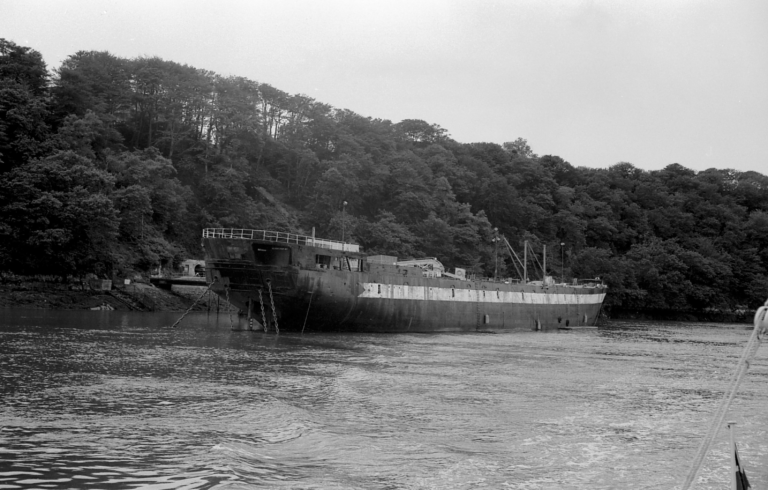
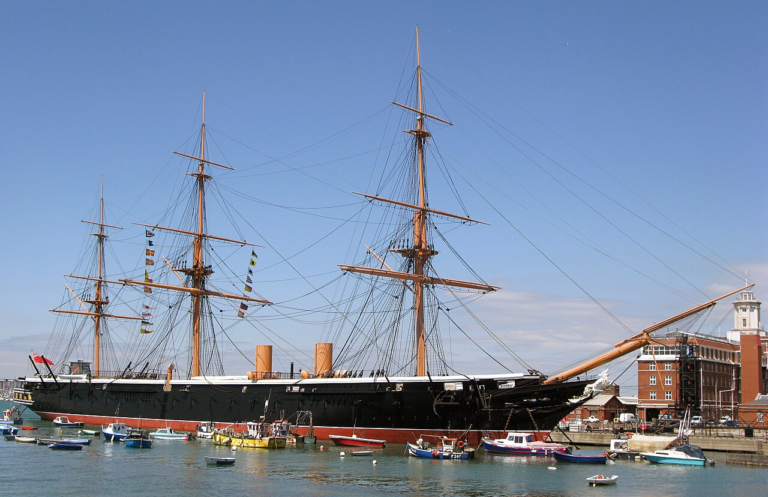
But luck intervened and a Trust was established to restore the famous ship to her 1862 state. Costing £ 9m, compared to the £ 377,000 for her original construction, Warrior emerged after a decade of renovation as a very impressive museum ship, moored at Portsmouth Historic Dockyard (near to the refloated Mary Rose and Nelson’s Victory).
Her jet-black 128-metre hull with its long row of gunports, her thrusting bowsprit and the weird co-existence of two stubby funnels and a full sailing rig make her a most intriguing looking vessel.
While some realism had to be sacrificed–her machinery are replicas of the originals; many of her guns are fibreglass dummies; and her retracting timber masts are now steel–Warrior today highlights a forgotten era of naval technology when the Royal Navy ruled the waves. She is the oldest armoured ship still afloat. And she does float!
Armada de Chile ironclad HUASCAR
After the Warrior, Huascar is the second oldest armoured ship still in existence. And, contrary to Warrior which never saw action, Huascar had a very interesting active career.
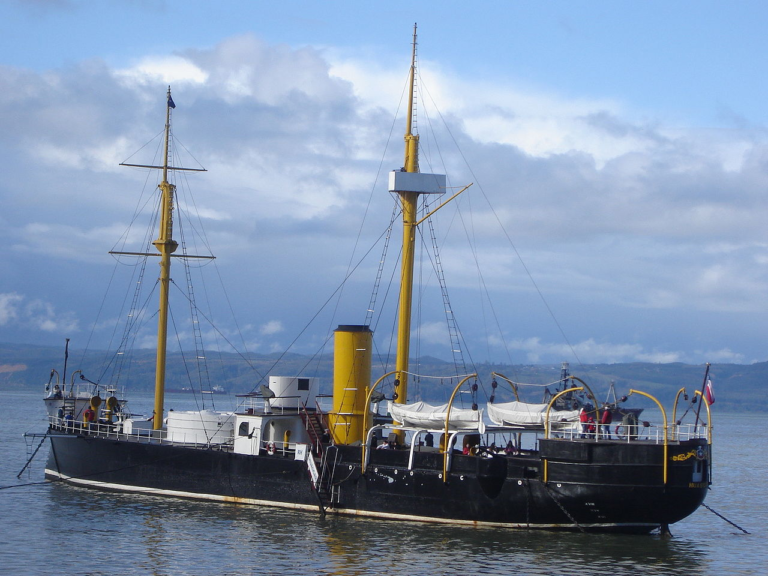
Ordered by Peru for the independence war against Spain, she was built by Lairds at Birkenhead, England in 1866 as a 67-metre long, 2000-ton ironclad turreted ship. Unlike Warrior’s broadside of guns, Huascar carried just two big ten-inch rifled breech-loaders in a traversable turret capable of firing broadly on each beam.
The concept was similar to that of the Union navy’s Monitor of 1861, but the better-designed Peruvian vessel was much larger, carried a sailing rig and was capable of transoceanic voyages. Which was unlike the Monitor that almost foundered making her delivery voyage and later did sink in weather conditions any sailing warship would have easily survived.
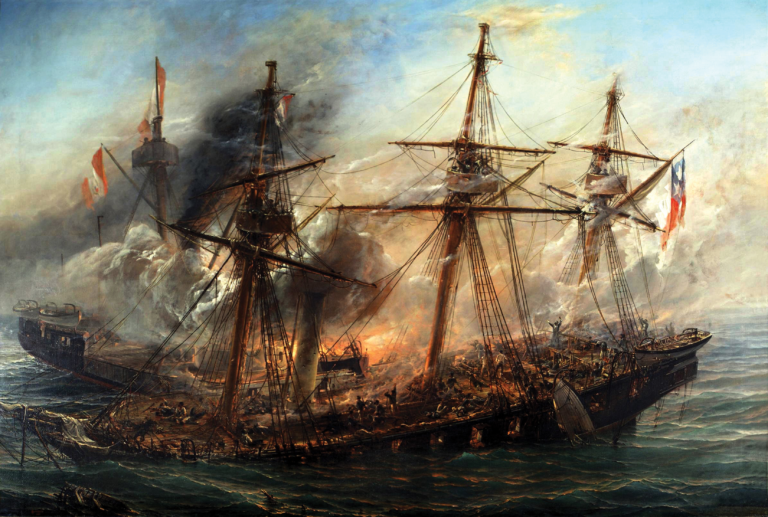
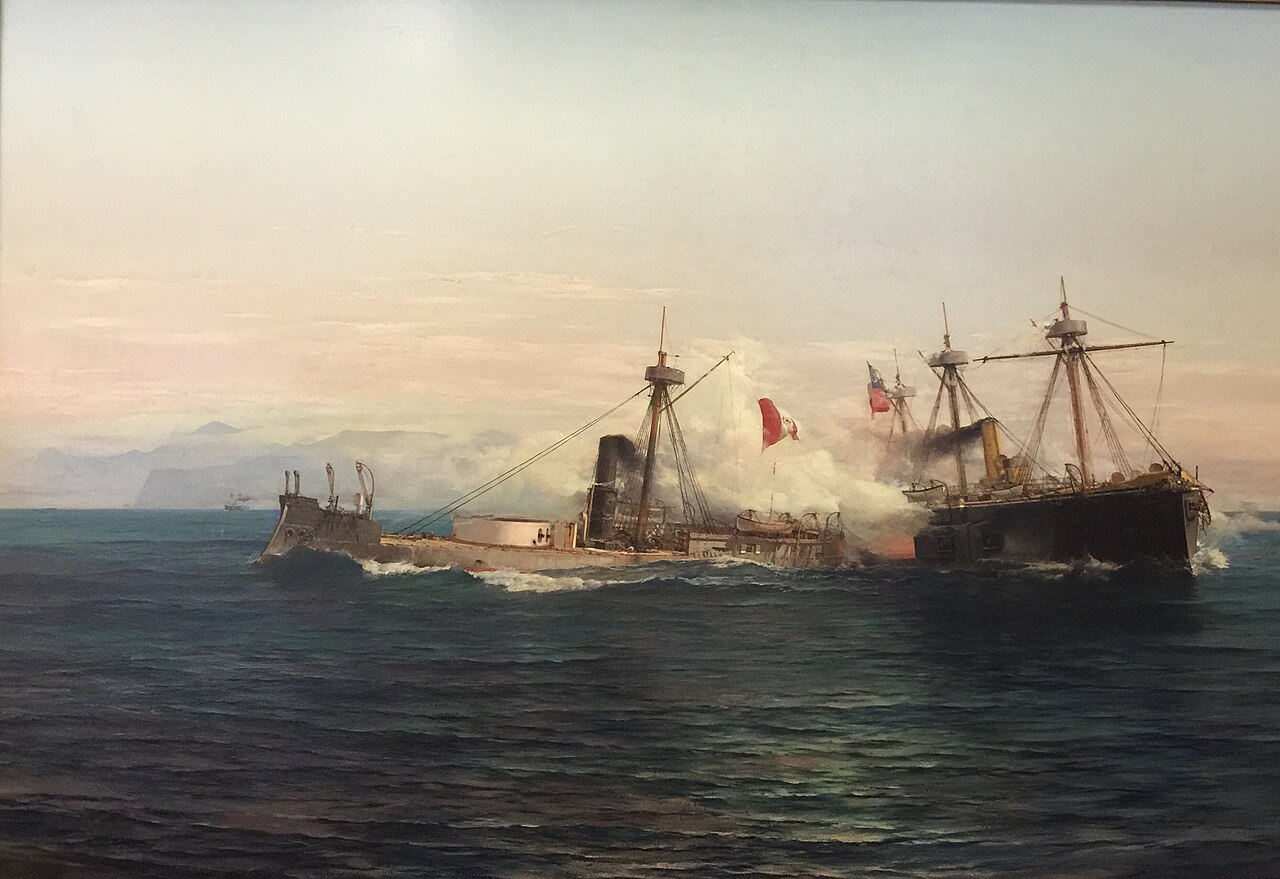
Huascar was taken over by rebels during the Peruvian Civil War, and harried trade along the coast, forcing the local Royal Navy squadron to intercept the ironclad in the fascinating Battle of Pacocha in 1877. The British iron-hulled steam frigate Shah peppered the Huascar with shellfire for two hours, all of which was observed to bounce off the rebel ship’s armoured sides. Luckily for the British, the rebels were terrible gunners, managing to get off only five poorly aimed rounds–any one of which would have sunk the Shah with their 300-pound shells.
Shah then fired a torpedo at Huascar; the very first use of this weapon at sea. The ironclad, with 1600 horsepower, managed to pull away from the torpedo at 12 knots, and retired to port, surrendering to government forces that night.
During a later war with Chile, Huascar sank a steam corvette by gunfire and ramming in one engagement but was caught in 1879 by two modern Chilean ironclads and battered to a wreck, taking more than 70 hits. Captured by the Chileans, Huascar fought against her former owners on several occasions, before being retired as a depot ship.
Because of her age and active service under three flags, she was reclassified as a museum ship in 1931 and restored to her 1897 state during the 1970s. She remains the oldest Chilean Navy vessel in existence, the only remaining ironclad turret ship afloat out of hundreds built, and on her decks two national heroes lost their lives leading boarding parties to seize the vessel (Peruvian Admiral Grau and Chilean Captain Prat).
Huascar today swings at her mooring, the great turret not immediately apparent, leading one to think she is perhaps some old tramp steamer, risen from the mists of the past. She can be inspected at Talcahuano Naval Base in Chile, the last of her breed.
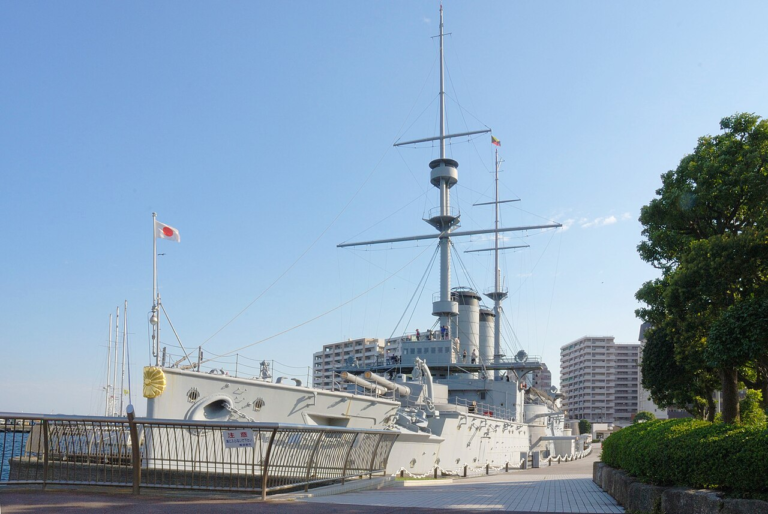
Imperial Japanese Navy pre-dreadnought battleship MIKASA
The very last of the world’s fifty-odd pre-dreadnought battleships and the only non-American battleship remaining afloat, the Mikasa holds a revered place in Japanese history.
British-built by Armstrong in 1900 for nearly £900,000, she displaced 15,000 tons, sported four big 12-inch guns in turrets and 14 six-inch weapons, and her 25 Belleville boilers produced 15,000 horsepower to drive her great bulk along at a maximum of 18 knots. She was protected by a 10-20 cm vertical belt of Krupp cemented armour and also a horizontal deck 8 cm thick, and stretched to 132 metres in length. She looks like a heavyweight: menacing, powerful and low, with two massive turrets, lofty masts and a blunt bow.
Flagship of the redoubtable Admiral Togo throughout the 1904-5 Russo-Japanese War, Mikasa led the Japanese fleet through the battles of Port Arthur, Yellow Sea and finally Tsushima, taking heavy damage in each. She suffered two hits by heavy guns in the first engagement, twenty in the second, followed by several months of repairs to ready her for the final winner-takes-all slugfest at Tsushima.
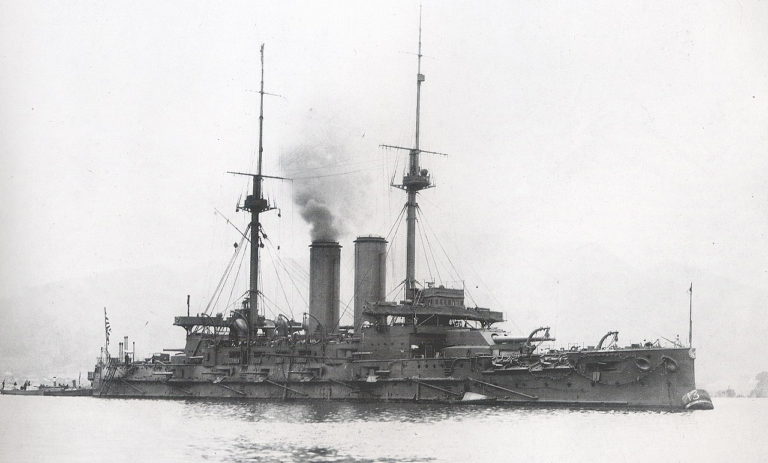
In this epic engagement, all the modern Russian battleships were sunk, while all the Japanese survived. It was the most decisive naval victory since Trafalgar in 1805. Mikasa, as always in the vanguard, took over forty hits, but it was her last battle.
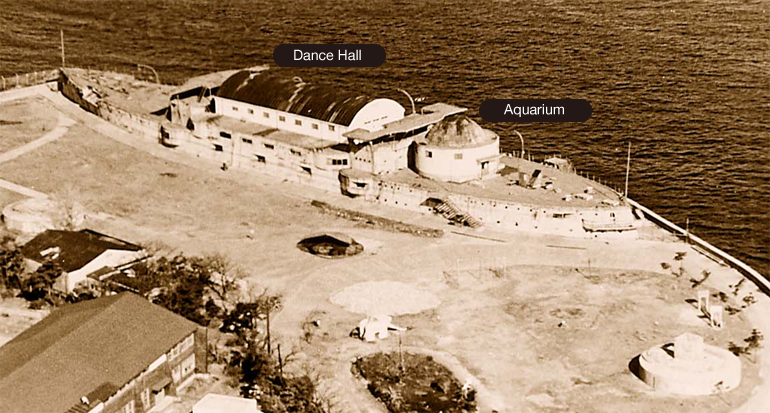
Her remaining active career was not without incident. She sank in harbour after a magazine explosion just after the war finished, but was soon raised and refloated. Seven years later, she nearly succumbed to one of her sailors trying to blow her magazine, but she survived, though he did not. She ran aground off Vladivostok but again endured. By the 1920s, technology had far overtaken her, and she was retired. Heavily damaged by US bombing during WWII, she suffered the humiliation of being converted to an aquarium and a US sailors bar before sense prevailed and she was put in hand for restoration.
This was completed in 1961, and she stands (not floats) today in a concrete pond at Yokosuka Naval Base, available for inspection.
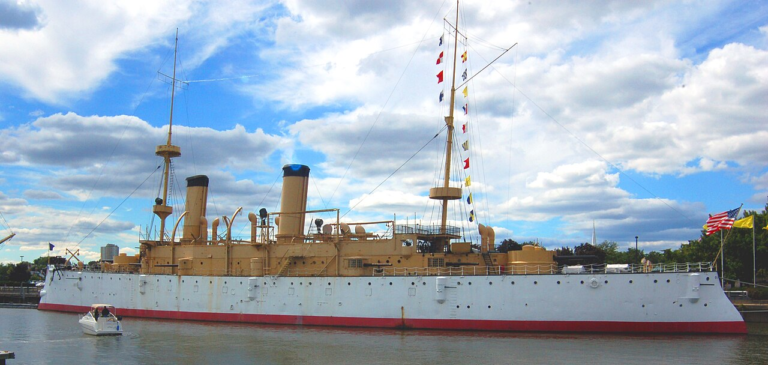
United States Navy protected cruiser OLYMPIA
The oldest American armoured ship still afloat, USS Olympia got her ticket to immortality as Commodore Dewey’s flagship when he destroyed a Spanish cruiser squadron at Manilla Bay in the Philippines in 1898.
This was the opening act of the Spanish-American War which began after the most powerful US ship, the battleship Maine blew up in Havana harbour. The Spanish empire at this time was a decrepit mess, and the warships available to defend Cuba and Manilla against American reprisals were a sad mix of obsolete, incomplete and undermanned cruisers and gunboats that stood no chance against more modern US ships.
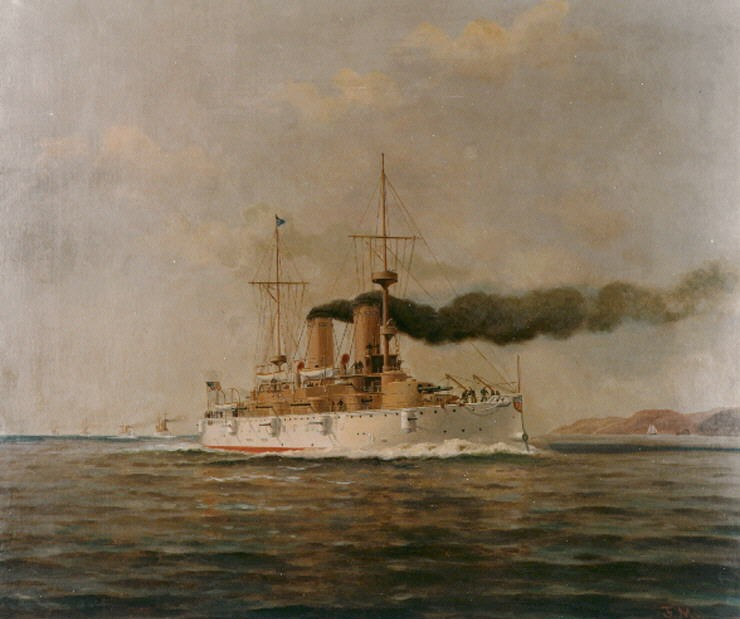
Completed in 1895, Olympia was just the third sea-going armoured ship built for the USN (after the battleships Texas and Maine). At 6000-odd tons, she was 105 metres long and developed 17,000 horsepower giving her a top speed of over 20 knots. Her crew numbered just over 400 men, she crammed 1000 tons of coal aboard for a range of 7000 nautical miles, and her big guns were four eight inchers in two twin turrets. Secondary armament included thirty smaller guns, and she was also fitted with four Gatling guns and six torpedo tubes. Twelve centimetres of plate armour protected her innards.
After her adventures at Manilla, Olympia had a busy but unspectacular career before being retired in 1922. She lay alongside, classified as a ‘relic’ until 1957, when a fund was established to manage her restoration to her 1898 glory days. The catalogue of this restoration and subsequent works, the challenges of upholding authenticity and the difficulties of securing funding illustrate the problems of preserving and maintaining old warships, long past their prime.
Managed first by the Cruiser Olympia Association, and since 1996 by the Independence Seaport Museum on the Delaware River at Philadelphia, she incurred costs of over $10m just to 2010, and then was estimated to require another $20m to drydock her and perform overdue maintenance. She came within an ace of being turned into a reef before national fundraising appeals sought more cash. Floating iron ships over a century old need constant maintenance, funding, volunteers and admission-paying visitors to stay above the waves.
She looks good, old Olympia, with her white hull and buff upperworks studded with turrets and casemates, and her sharp ram bow. Well worth a look.
Imperial Russian Navy protected cruiser AURORA
Owing her ongoing survival to firing the opening shots of the 1917 October Revolution which deposed the Romanov Tsars, the Aurora was another cruiser that witnessed momentous events.
Launched in 1900, she commissioned just in time to accompany the Russian Baltic Fleet on their round-the-world-ordeal to the Far East to avenge the fate of the Russian Pacific Fleet, bested by Mikasa and Togo, and later sunk at anchor in Port Arthur by Japanese artillery.
Leaving St Petersburg in October 1904, Aurora suffered ‘friendly fire’ in the English Channel, sailed around Africa and all the way to Korea–over 15,000 nautical miles–before witnessing the destruction of the fleet at the hands of the Japanese in May 1905. She survived the battle with little damage, but lost her captain and was interned at Manilla.
Released, she returned to the Baltic and carried out patrolling duties until 1917. While lying at St Petersburg, her crew mutinied, shot the captain and officers, flew the red flag of revolution and opened fire on Tsarist forces defending the Winter Palace. The consequences remain with us today.
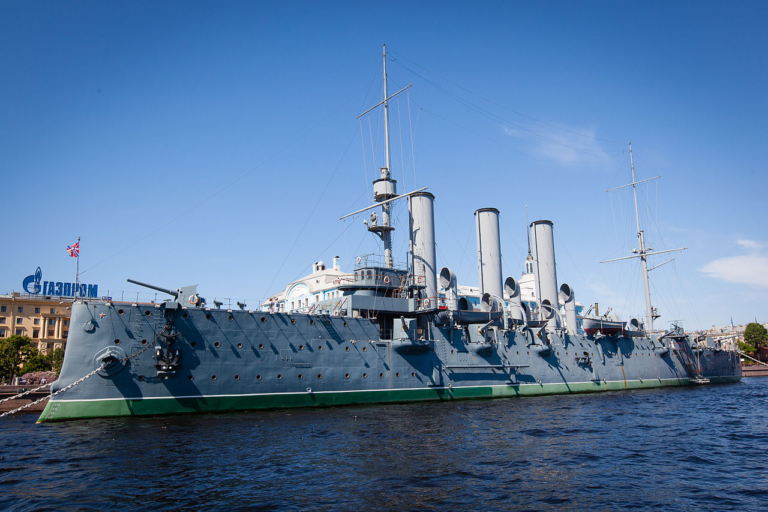
At 127 metres in length and 7000 tons, Aurora is a little larger than Olympia but was slower and not as well armed. Slab-sided and with a little tumblehome amidships, she looks a little awkward, without the sleeker, appealing balance of the American cruiser.
Bombed and sunk in WWII, she was raised postwar and refitted as a monument to the birthplace of the Revolution. By the 1980s her hull had decayed to the point that it needed to be completely replaced–an enormous task. Again, in 2004, major reconstruction was required; an indication of the enormous amount of upkeep old warhorses require.
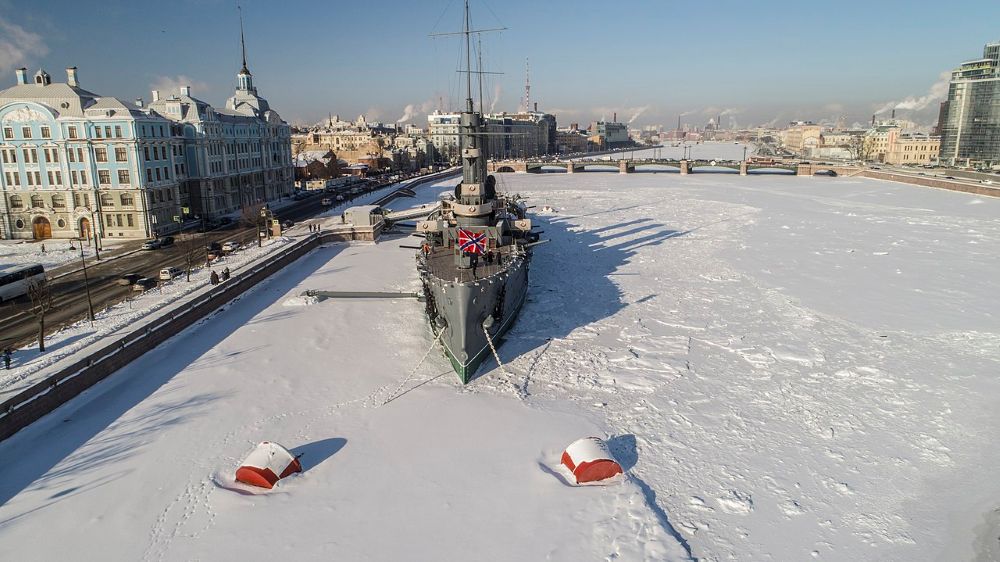
Now Aurora sits on the Neva as a museum ship, not far from the Winter Palace (today the Hermitage), encased by ice all winter, well into her second century. She flew the Tsar’s flag, the Soviet flag, and now sports the flag of Russia.
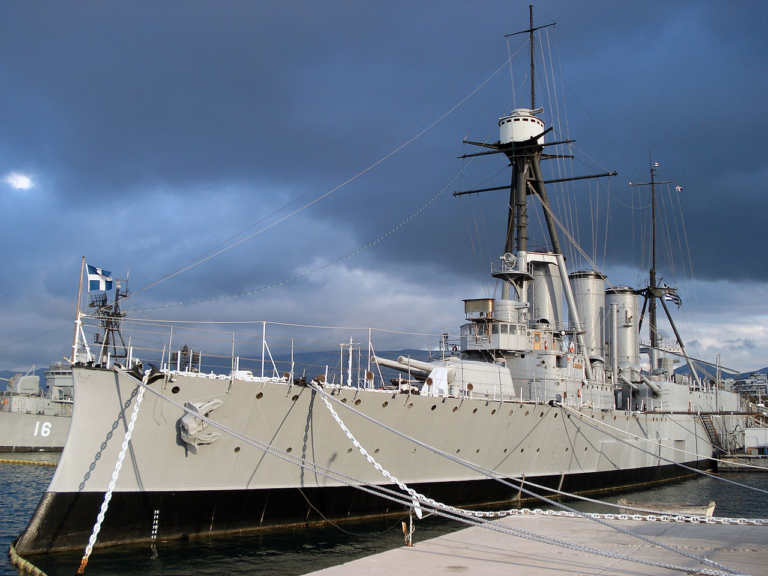
Royal Hellenic Navy armoured cruiser GEORGIOS AVEROF
Of the dozens of armoured cruisers that served in the British, German, French, US, Japanese, Russian, Italian and Greek navies, only one remains; the Greek Averof. This class of ships was envisaged as a long-range commerce raider, powerful enough to destroy any cruiser that could catch it, but fast enough to escape any battleship that could outgun it.
Studded with three or four funnels and pin-cushioned with casemated guns, armoured cruisers were ponderous, ungainly ships, always belching clouds of coal smoke. When the faster, more heavily-armed battlecruisers arrived on the naval scene in 1906, all armoured cruisers were obsolete, and no more were laid down. Battlecruisers were much more sleek and powerful looking ships, but of the thirty-odd completed, sadly not one was saved from the scrappers yard.
The Greek navy was seeking new heavy ships prior to WWI and snapped up a cancelled Italian design from the Pisa-class. It had German armour, French boilers, British guns and Italian machinery, and the 30% down payment (from a price of £1m) was made by a Greek patriot who the ship was named after. Construction took time, and launched in 1911, she was the very last of the armoured cruisers, and already obsolete.
Averof hammered several older Turkish battleships during the Balkan Wars and singlehandedly forced the withdrawal of Turkish naval forces from the Aegean. During WWI Greece was neutral, and she was later rebuilt in France in the 1920s, before fleeing the German invasion of Greece in 1941. For the remainder of WWII, she escorted convoys in the Indian Ocean, limited by her ancient engines and appalling low speed (at times 9 knots).
She was relegated in 1952 and moored for another 30 years before it was decided to restore her to former glory, showcasing Greece’s long maritime history. She was refurbished again in 2017, remains a commissioned naval vessel flying an admiral’s flag and is saluted by every passing Greek warship.
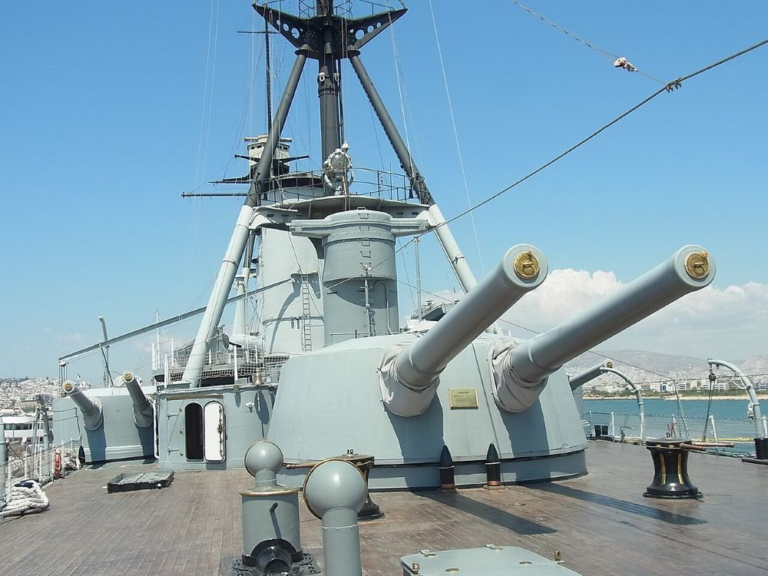
Today she can be found at Faliro near Athens, forming part of a vibrant maritime themed district. A replica trireme and an old destroyer lie nearby. With her attractive colour scheme, prominent turrets, tripod masts, raked bow and triple funnels, she is a proud and imposing throwback to another era, and a delightful trip back through history.
How refreshing it is to still have the opportunity to climb aboard and inspect Averoff and these other last handful of armoured ships who ruled the waves for a century with their imposing might. A look at their swivelling turrets, steam engine rooms, command bridges, captain’s cabins, sailor’s quarters and slabs of armour is a journey back to a world that was with us for a very long time through tremendous technological change, and now remains only in this small group of impressive warships. Climb aboard, if you can!
Honourable and dishonourable mentions
Not really armoured ships, but interesting nevertheless, the former WWI Austro-Hungarian river monitors Sava and Leitha can be seen proudly restored in Belgrade and Budapest respectively.
HMS Caroline, a C-class light cruiser built in 1914 is the last survivor of the Battle of Jutland, most famous of all the great stoushes of armoured ships. She can be inspected in Belfast.
And speaking of Jutland, the Danish steam frigate Jylland which served from 1862 to 1908 can be seen at Ebeltoft, Denmark. Another crazy steam-powered vessel with funnels and a full sailing rig!
And speaking of Belfast, how could we forget the beautiful Town-class light cruiser from WWII of that name that sits proudly in the Thames at London, an epoch away from Jylland in design.
A pair of American cruisers, USS Salem, last of the heavy cruisers, and USS Little Rock, a Clevland-class light cruiser, are also museum ships. Surviving battleships in the US include the Alabama, Iowa, Massachusetts, Missouri, New Jersey and North Carolina.
In terms of dishonourable mentions, this is a list of armoured ships that in recent decades lost the battle with the scrapyard when preservation should have been the goal. The German battlecruiser Goeben, originally from the Imperial German Navy, then served with the Turkish Navy until 1950 but was tragically scrapped in 1976. She was the last of the battlecruisers.
The Royal Victorian Navy monitor Cerberus, of the same vintage as the Huascar served from 1870 until 1924, was scuttled in 1926 off Melbourne. She has laid semi-submerged for a century but until recently was recoverable and still mounted her original guns. Tragic.
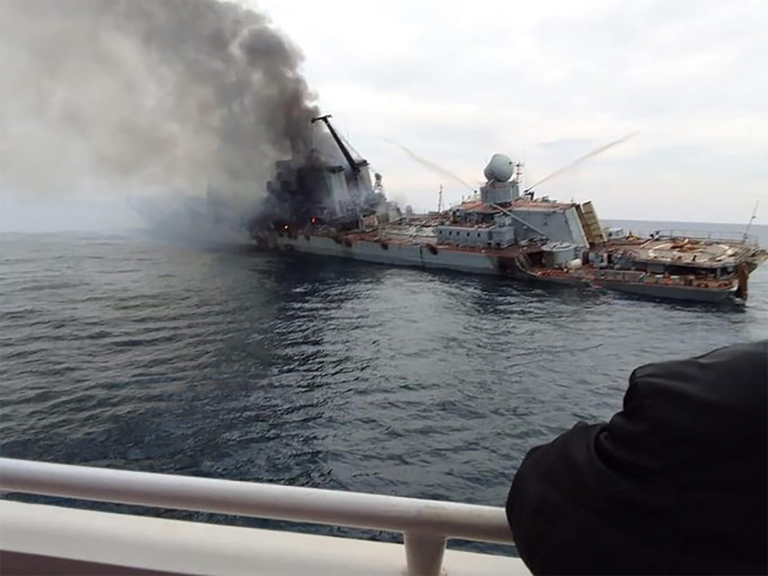
Other late model cruisers that did not survive recent decades were the Indian Navy Delhi, which started life as HMS Achilles and fought at the Battle of the River Plate in 1939 but succumbed to the breakers in 1977; the French Colbert, scrapped in 2016; the Argentine Belgrano which as the USS Pheonix survived the attack on Pearl Harbour, but was sunk off the Falklands in 1982; the British-built Spanish Canarias launched in 1931 and scrapped in 1977; and the Russian Slava-class Black Sea Fleet flagship Moskva, humiliatingly sunk by a country with no navy in 2022.
Inspiration for this post comes from Ian Marshall’s excellent book, Armoured Ships.