
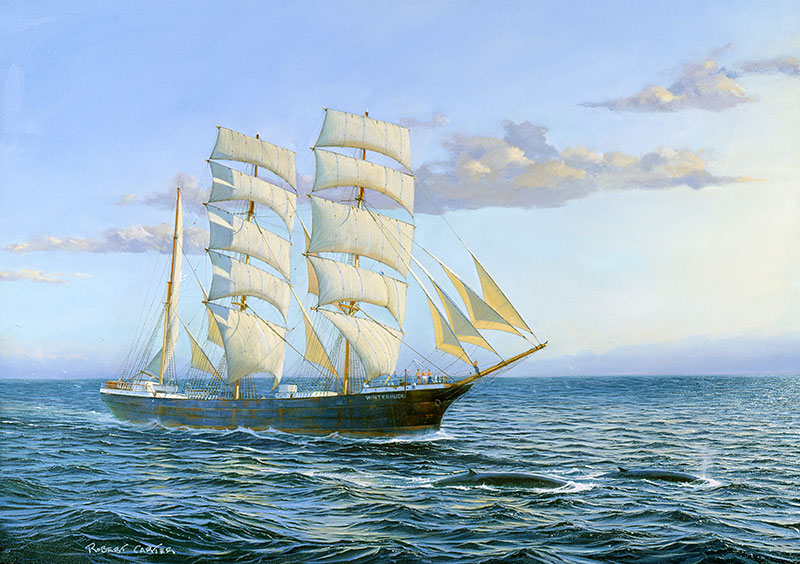
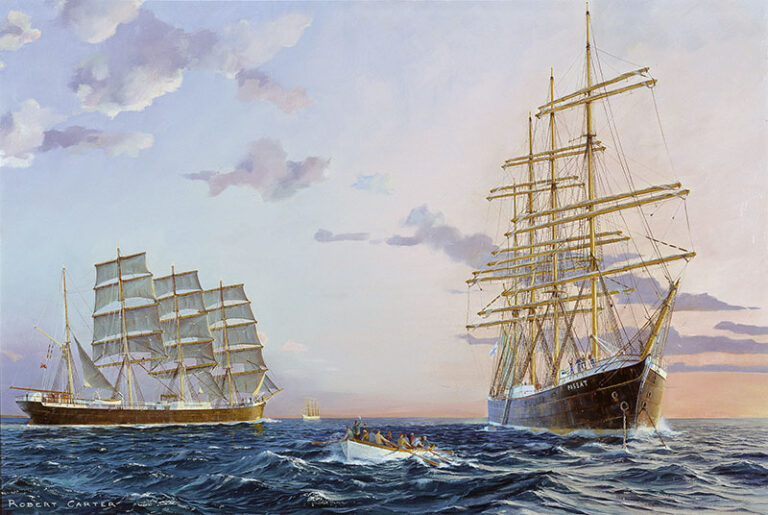
In May 1949, two great barques lay off the South Australian town of Port Victoria. They were magnificent ships, but among the last of a breed. Twenty centuries of transoceanic wind-powered cargo operations would come to an end with their next voyage.
The sleek four-masters with their rakish bowsprits and soaring rigs lay at anchor where the Eyre Peninsula sheltered them from the westerlies of the Roaring Forties; year-round gale force winds that howl around the world, below 40 degrees south.
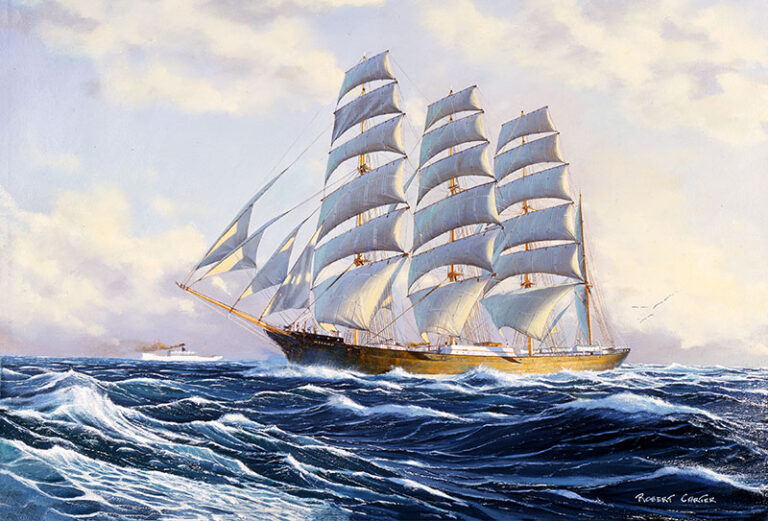
Once loaded with grain, the two barques would poke their bows out into the wild Southern Ocean, turn east for the rising sun, and plunge through the great swells to the legendary Cape Horn, 6000 sea-miles away. From the Cape it was another 8000-odd sea-miles to England. A good run for both legs was 100 days.
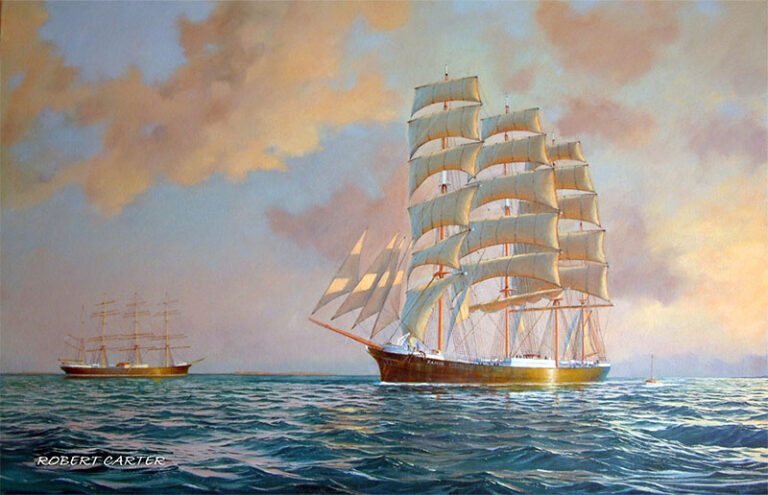
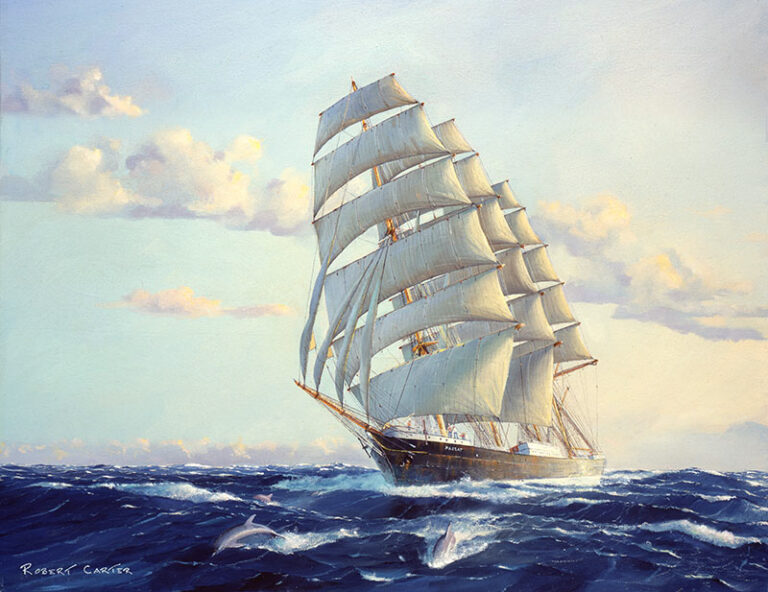
The two ships were starters in the very last of the Grain Races, bringing barley from Spencer Gulf to Falmouth, UK, for ‘orders.’ Pamir and Passat were both steel hulled nearly 120 metres (400 feet) long, 14 metres broad, and with four masts reaching up to 55 metres high.
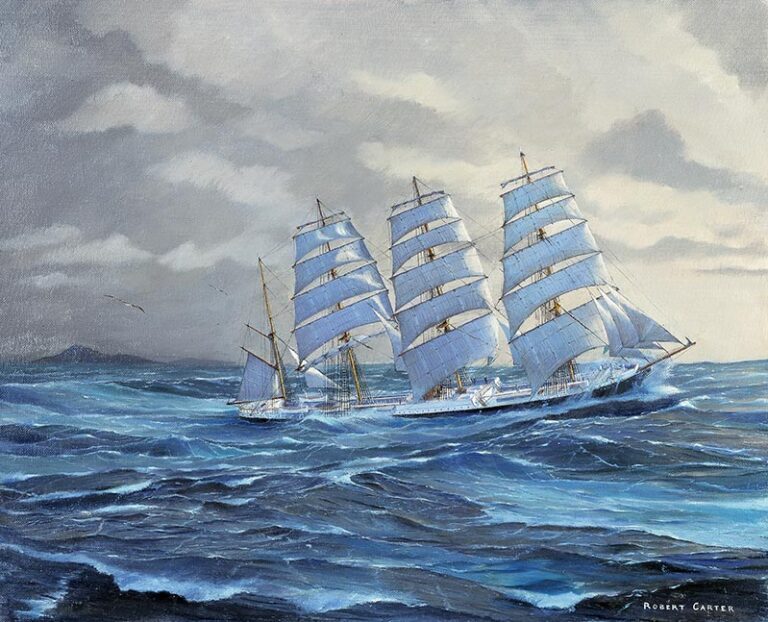
On the three forward masts, when underway, they wore six square sails stacked one upon the other, reaching up from the main to the topsail, topgallant, royal and up to the aptly named skysail. The rear, or mizzen mast, carried fore-and-aft sails with a gaff rig–thus; the essential visual difference between a ‘fully-rigged ship’ and a barque being that the ‘ship’ has square sails above the mizzen sail, or spanker, where a barque has a fore-and-aft gaff topsail instead of square sails.
On top of their 18 square sails and two gaffs, they flew four jibs off the raking bowsprit, and up to three staysails between each of the forward masts, giving a total of at least 30 sails.
Such ships were run by a crew of two to three dozen men, which is not a lot for nearly 4000 square metres of sail, 66,000 bags of grain and three watches around the clock through the great swells and howling winds of the Roaring Forties.
Steam takes over
Regular transatlantic steamship services began with Brunel’s side-paddle SS Great Western in 1838. The first steam ship to round the Cape of Good Hope and sail to Asia, a British gunboat named Nemesis, arrived in Singapore in 1840. And in 1869 the Suez Canal opened, shortening the distance between the English Channel and Singapore from 12,000 to 8000 nautical miles. These were all portents of a new era in maritime trade. The days of long-distance sailing cargo ships were numbered.
It was not so much the economies of smaller crews that beat the tall ships–steamers needed a large contingent of coolies to shovel coal into the furnaces–but more that they could proceed in calms, and even against the wind. Seasons no longer mattered; the Doldrums be damned. And there was, of course, a great attraction in being able to reliably forecast a voyage’s duration.
Still, it took decades for sooty, coal-burning steamers to kill off the clippers and the barques completely. The glorious era of the clippers ranged from the mid to late nineteenth century, and following their demise, the great barques still crossed the oceans until World War II. And a little bit after.
Spencer Gulf
There were a number of ports around Spencer Gulf that loaded the grain ships; Port Lincoln, Wallaroo, Port Broughton, Port Germein and Port Victoria. Nick Brink, at the time an ordinary seaman, recalls the latter port in 1933, as he was picking up a cargo aboard Winterhude, from Robert Carter’s Windjammers: The Final Story…
In Port Victoria we worked every day except Sunday, although we would have to wash down the decks and tidy up before we could go ashore. It took several hundred buckets of water to wash down the decks, and this had to be sea water, hauled up by hand, even though we had pumps. We would row ashore to the Wauraltee Pub on the waterfront at the end of the main street, known by grain fleet sailors the world over.
Our weekly wage of two shillings and sixpence brought us a packet of Players cigarettes for sixpence and a bottle of wine for two shillings. We would go down to the beach and consume the result of our week’s work in several hours.
The Finland Connection
It is astonishing that two places on the globe so distant and different came together to be associated with the last of the long-distance windjammers, as Spencer Gulf and Mariehamn in Finland’s Aland Islands have done.
Nearly 15,000 nautical miles of some of the world’s toughest oceans lies between them, a passage ranging from 36 degrees south to 60 degrees north with notorious navigational dangers like Bass Strait, Cape Horn, the English Channel and the Danish Straits to clear. It was an arduous link under the best of conditions.
But Gustaf Erikson hailed from Mariehamn, and he ran the very last fleet of square-riggers to grace the world’s oceans. At sea since the age of nine, master of his own barque just a decade later, he had an eye for prime windjammers, and was most definitely not interested in steamships. During the 1920s, he began snapping up fine square riggers that had gone out of fashion with most shippers and were being offered at throw-away prices.
By 1930 his fleet of barques and schooners was the largest in the world, and he owned half the two-dozen-odd tall ships involved in the annual grain races to South Australia. This included legendary speedsters like Moshulu, which made Chile from Newcastle, NSW in 31 days, and carried author Eric Newby in one of the grain races; Lawhill which could top 17 knots and shipped the famous author Alan Villiers for a time; and Herzogin Cecilie, which was one of the fastest tall ships ever, topping 21 knots in a North Sea gale.
The Aland Islands had a long history of building and operating wooden sailing ships in challenging sub-Arctic conditions, manned by tough, hard men schooled in the rigours of the bleak Baltic and the storms of the North Atlantic. It was home to Erikson and a lot of old sailors and young lads who still, in the 1920s and 1930s chased the thrill and adventure of long-distance, blue-water sailing.
Spencer Gulf held the sheltered waters that bordered the baking, endless wheatfields of South Australia, and these fields produced a crop uniquely available six months after harvest in Europe, when prices were high. It also lay on the race track of the circumnavigator who sought the strongest constant winds on the planet to carry their cargoes. And it was not a route for steamships. The Grain Races would be the last hurrah for these magnificent sailing ships.
The Races
To be honest, the Grain Races were not pursued with the same insane determination as the earlier clipper era Tea Races. Extreme clippers of the late nineteenth century were once defined as having three differences to other fully rigged sailing ships: they had to be ‘sharp’–designed for speed not cargo space; they must be heavily sparred (masts, booms and yards) to allow carriage of the maximum possible canvas; and they needed to have a speed-crazed daredevil in command.
The grain races were more subdued, but still contested. They were not a race where all the ships lined up and started together, but they were races in the sense of elapsed time: how many days to make Europe. Firstly, in 1921 the Finnish-flagged Marlborough Hill took the honours in 91 days from Port Lincoln to Cobh, Ireland. A day was shaved off that the next year, and three days the year after. In 1933 the barque Parma, of Mariehamn, made Falmouth from Port Victoria in 83 days; a record that still stands. And its fair to say, will never be broken with a load of grain under sail.
Erikson’s barques always put in a good showing, and his Pommern, Pamir and Herzogin Cecilie all took the podium in various years. With war on the horizon, 13 barques set out from Spencer Gulf in 1939, ten of which were Erikson ships. Loaded after the harvest, they left Spencer Gulf starting in February, and except one, they made it to British or Irish ports before the conflict kicked off. Erikson’s Moshulu took the honours that year, and many called it the end of the races.
Post War
When World War II began, there were still 27 sail-powered cargo-haulers gracing the world’s oceans, a mix of three and four masted barques. Due to shipping shortages, they had a brief reprieve, but the war claimed a number of them. Erikson’s Penang was sunk by a U-Boat in 1940 with all hands, his Killoran scuttled by a raider and Olivebank went down after hitting a mine.
Pommern, Viking and Passat were laid up at Mariehamn for the war’s duration. Padua, owned by a German firm, worked in the Baltic, as did Moshulu. Other ships were interned or seized for postwar reparations. Winterhude and Archibald Russel were laid up and never took to the oceans again. Lawhill, Erikson’s first ship, which sailed the whole war between Cape Town and Australia was awarded to the South Africans, sailed for a few years but was then run aground and left to rot. Pamir was seized by New Zealand.
Old Gustaf Erikson passed away in 1947, but his son, Edgar decided to have one last Grain Race with the last of his square-riggers. Only two could be made ready to pass the safety surveys; Pamir and Passat. They arrived in Spencer Gulf from Wellington and London respectively, and loaded grain for the last time. On 29 May 1949, Pamir sailed for Cape Horn, and Passat departed two days later.
Passat overhauled her sister, and passed Cape Horn in daylight in the depths of the southern winter; the last engine-less commercial sailing ship to sight the famous landmark. Aussie deckhand Bob Russell aboard Passat describes it, and helps you understand why it was such a memourable experience (again thanks to Robert Carter’s book) …
At 2 bells in the afternoon watch, when we went up to change the main upper t’gallant, Bill sighted the Horn on the horizon. By 7 bells we were abreast of it and what a sight! I suppose it would be about a thousand feet at its four peaks and about a mile square. We could see great breakers crashing into its rocky sides and snow-covered peaks rising up. In the background were the great Andes Mountains standing out like great white pyramids rising up to the heavens. It is a sight I won’t forget for the rest of my life.
Pamir rounded the ‘Horn during the night of 11 July, too far to the south to sight it, leaving Passat to claim the final sailing ship view of the legendary Cape. Passat made Queenstown, Ireland on 19 September 1949 after 110 days out of Port Victoria. Pamir made Falmouth the next day. But there were no losers in that last race; every man aboard held a memory immortal.
Survivors
A sad ending of the era followed. After their last epic passage, both elegant barques were laid up in Wales as storage ships, then, when it became clear there was no further economic use for them, they were sold to shipbreakers. Maintenance, increasing regulation, crewing and insurance were ongoing problems.
A German syndicate came to the rescue just in time. They were converted to cargo/ training ships, and fitted–for the first time–with auxiliary engines. Transatlantic crossings to South America during the fifties continued for the two ships.
But in September 1957, disaster struck. Pamir went down in an Atlantic hurricane 600 nautical miles south-west of the Azores. Eighty of the 86 aboard were lost with the ship. Germany and the sailing world were in shock. Investigations revealed the cargo was poorly packed and shifted during the storm, the hull leaked and the radio was not properly monitored. Much criticism was levelled at the master, who was relieving the normal captain, but who did not survive the disaster.
In any case, it was the last nail in the windjammers coffin. Passat was removed from service. Luck once more intervened, and just before succumbing again to the breakers, she was bought by the Hansa port Lübeck and moored at nearby Travemünde, where she can still be seen today.
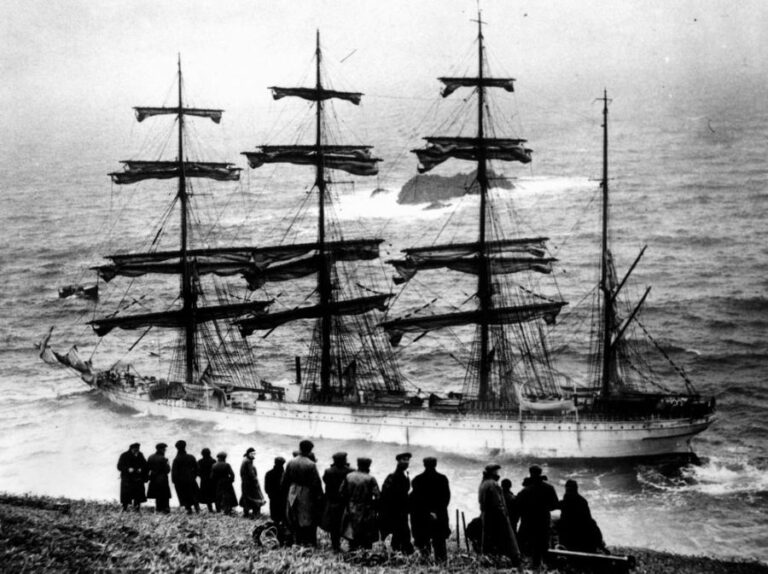
Poor Moshulu suffered a greater indignity, being converted into a restaurant at Philadelphia, where she remains, garishly modified. Parma had been scrapped in 1938, and Herzogin Cecilie had been wrecked in 1936 at Devon.
But thankfully, some of the elegant barques survived. The big Peking, purchased as a wreck for $100 in 2015 has been extensively refurbished to serve as a centrepiece of Hamburg’s Maritime Museum. The Viking, built in 1907 and winner of the 1948 Grain Race, also an Erikson ship, was saved by the Swedes and lies today preserved for inspection at Gothenburg. Last but not least, and perhaps most fittingly, the beautiful Pommern, winner of the 1930 and 1937 Grain Races lives on at Mariehamn, in the Aland Islands of Finland, where old Gustaf Erikson lies.
It is fitting that four of the last elegant barques remain in (or near) the Baltic Sea. It is a great pity that none still lie in Spencer Gulf, though there is the Polly Woodside in Melbourne and the James Craig in Sydney to remind us of past glories, when the oceans were wide, wild frontiers to be challenged by tough men in magnificent windjammers.
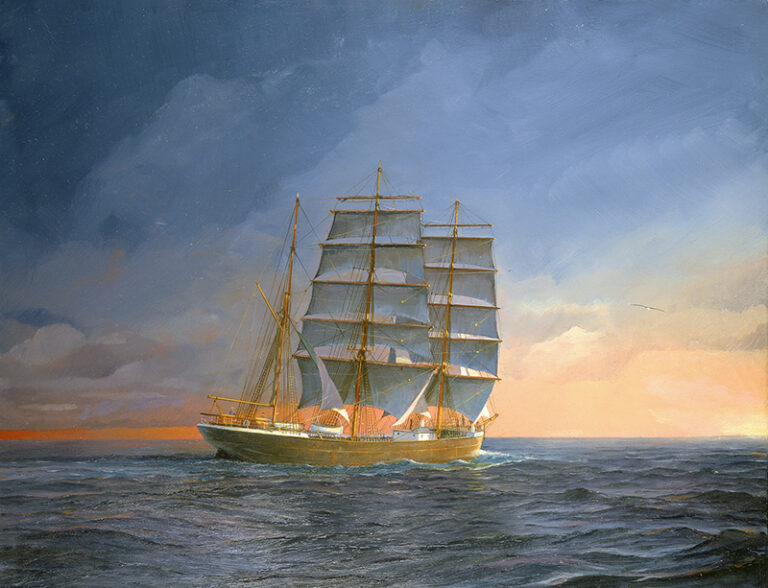
Many thanks to Robert Carter (Order of Australia Medal), a brilliant marine artist and tall ship sailor, whose great account of the final days of sail, Windjammers: The Final Story provided the inspiration for this post. All illustrations provided with permission.